Event Published ResearchPerplexity AI
Researchers Detail Byzantine-Resilient Defense For Federated Large Language Models
A new paper proposes a hypergraph defense for federated large language models, the kind of collaborative training an answer engine like Perplexity AI could one day rely on.
What happened
Published here
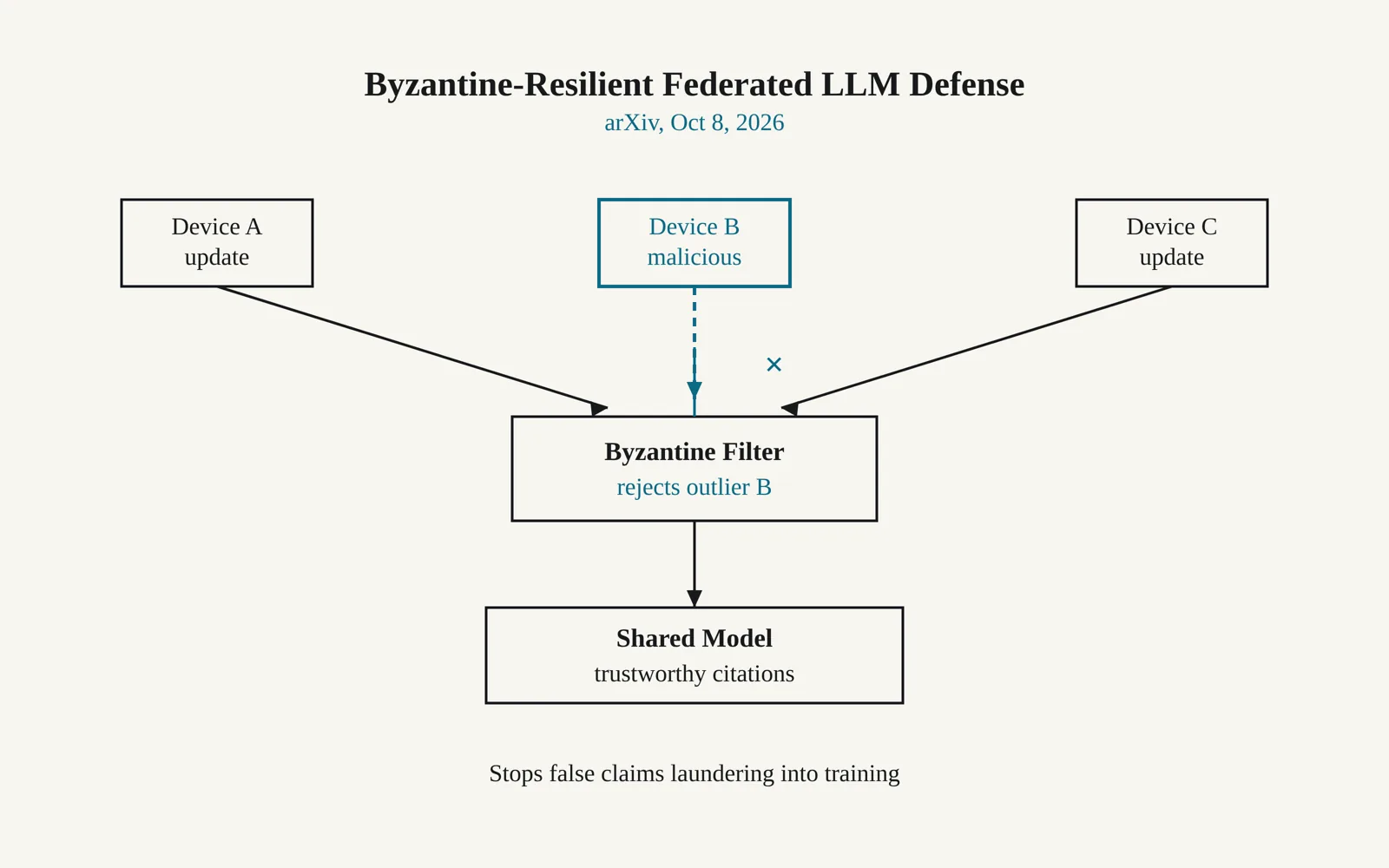
On October 8, 2026, researchers posted a paper to arXiv describing a defense against Byzantine attacks on federated large language models, where malicious model updates from participating devices or agents can corrupt the shared model's factual consistency during decentralized training without anyone touching the private data behind it. (arXiv preprint 2610.12711, Byzantine-Resilient Federated Large Language Model via Hypergraph Message Passing, submitted October 8, 2026)
Open the photograph at full size
Photograph: Diagram: AI Journey
Read the full description of this diagram
Diagram drawn for this item: Researchers Detail Byzantine-Resilient Defense For Federated Large Language Models. On October 8, 2026, researchers posted a paper to arXiv describing a defense against Byzantine attacks on federated large language models, where malicious model updates from participating devices or agents can corrupt the shared model's... For a service whose whole product is an answer engine that reads widely and writes back prose, a cheap way to launder false claims into a shared model during training is a direct threat to whether its citations can be trusted, so a defense...
What it means for you
For a service whose whole product is an answer engine that reads widely and writes back prose, a cheap way to launder false claims into a shared model during training is a direct threat to whether its citations can be trusted, so a defense like this one lands on the choice of how much decentralized training such products can safely accept before output quality is quietly degraded by poisoned contributors.
In more detail
Eight researchers, including Kai Li, Hanlin Cai and Falko Dressler, posted a paper on October 8, 2026, addressing a weak point in federated large language models: the decentralized training process that lets many agents contribute updates without sharing their private data also lets one dishonest agent corrupt the shared model’s grasp of facts. A single malicious update, folded into aggregation along with everyone else’s honest ones, can drag the whole model toward confident but wrong answers, and nothing about the usual federated setup stops that from happening quietly.
The paper’s answer is a framework the authors call a Hypergraph Message Passing Graph Autoencoder, or HMP-GAE. Rather than treating each participant’s update in isolation, it represents the low-rank model updates as nodes on a hypergraph and passes messages between them to surface high-order relationships among several agents at once. By comparing a new update against historical checkpoints and against how other agents’ updates relate to one another, the system flags updates that break the model’s semantic consistency and suppresses them before they can spread through the rest of the network’s training round.
The authors tested HMP-GAE on two pretrained backbones, Qwen-2.5 and Llama-3.2, running classification tasks on the AG News and Yahoo Answers datasets. Measured against other existing Byzantine defenses, HMP-GAE raised global accuracy, cut the final model’s classification semantic entropy, and lowered its perplexity. Against a plain graph autoencoder baseline without the hypergraph structure, the gains were larger still. The paper credits this to the extra signal that comes from modeling relationships among several agents together rather than checking each one alone.
The numbers
- Global accuracy rose by 1.21% compared with existing defenses.
- Classification semantic entropy in the final model fell by 44.08%.
- Model perplexity dropped by 13.34% against existing defenses.
- Against a GAE-based baseline specifically, semantic entropy fell by 54.5%, a larger margin than against the wider field of defenses.
The work sits squarely in a gap that matters to any company building a model from decentralized contributions rather than a single curated pipeline. Federated training promises privacy, since raw data never leaves a participant’s device, but that same privacy makes it harder to audit what each contributor actually sent. A defense that works by watching the shape of updates across many agents, instead of inspecting the data behind any one of them, is the kind of method that could let a product built on collaborative training keep its privacy promise without quietly absorbing bad information from a handful of bad actors.
Sources
Sources read
Cite this
AI Journey, "Researchers Detail Byzantine-Resilient Defense For Federated Large Language Models", 12 Oct 2026, https://aijourney.space/updates/2026-10-12-byzantine-resilient-federated-large-language-model-via-hypergraph-messag/ (source: arXiv, verified 12 Oct 2026)
Next in the stream
A New Paper Proposes a Unified Benchmark for AI Game Commentary
A new arXiv preprint introduces GameCommBench, a benchmark testing whether AI systems can produce usable live commentary across board games, sports and esports.
Previous
New MathVis Benchmark Tests Claude and Rivals on Diagram Reasoning
A new benchmark called MathVis found Claude Fable 5 and rival models struggle to reason through drawing on frontier mathematical problems.
Next
More in Perplexity AI
Perplexity AI Researchers Detail LoRA Recipe For Converting Four Language Models To Diffusion
A paper associated with Perplexity AI describes BYOD, a LoRA-only method that converts standard autoregressive language models into diffusion language models without full retraining.
Paper Proposes Message-Passing Method For Compressing LLM Weights
A new arXiv paper proposes a message-passing method for compressing large language model weights, the kind of efficiency work that underlies answer engines like Perplexity AI.
Researchers Publish S-SALAAD Framework For Sparse Large Model Inference
A new paper on compressing large models for edge devices matters to Perplexity AI and any company whose answer engine has to run inference away from a data center.