Event Published ResearchPerplexity AI
Paper Adds Input-Dependent Readout Phase To Resonant Sequence Models
Filed here under Perplexity AI, a paper posted October 12, 2026 gives ResonatorLM style sequence models a readout phase that reads the current token instead of a fixed per-head setting.
What happened
Published here
On September 26, 2026, a paper titled An Input-Dependent Readout Phase for Resonant Sequence Models was submitted to arXiv, describing a change to ResonatorLM, a fixed-size state sequence model that reads a bank of damped complex oscillators through a learned phase per head. The authors make that readout phase a function of the current token rather than a fixed setting, which adds content dependence to the read step while keeping the O(T log T) convolutional training path exact and adding 0.2 percent more parameters. (arXiv paper 2610.12496, An Input-Dependent Readout Phase for Resonant Sequence Models, submitted September 26, 2026)
Open the photograph at full size
Photograph: Diagram: AI Journey
Read the full description of this diagram
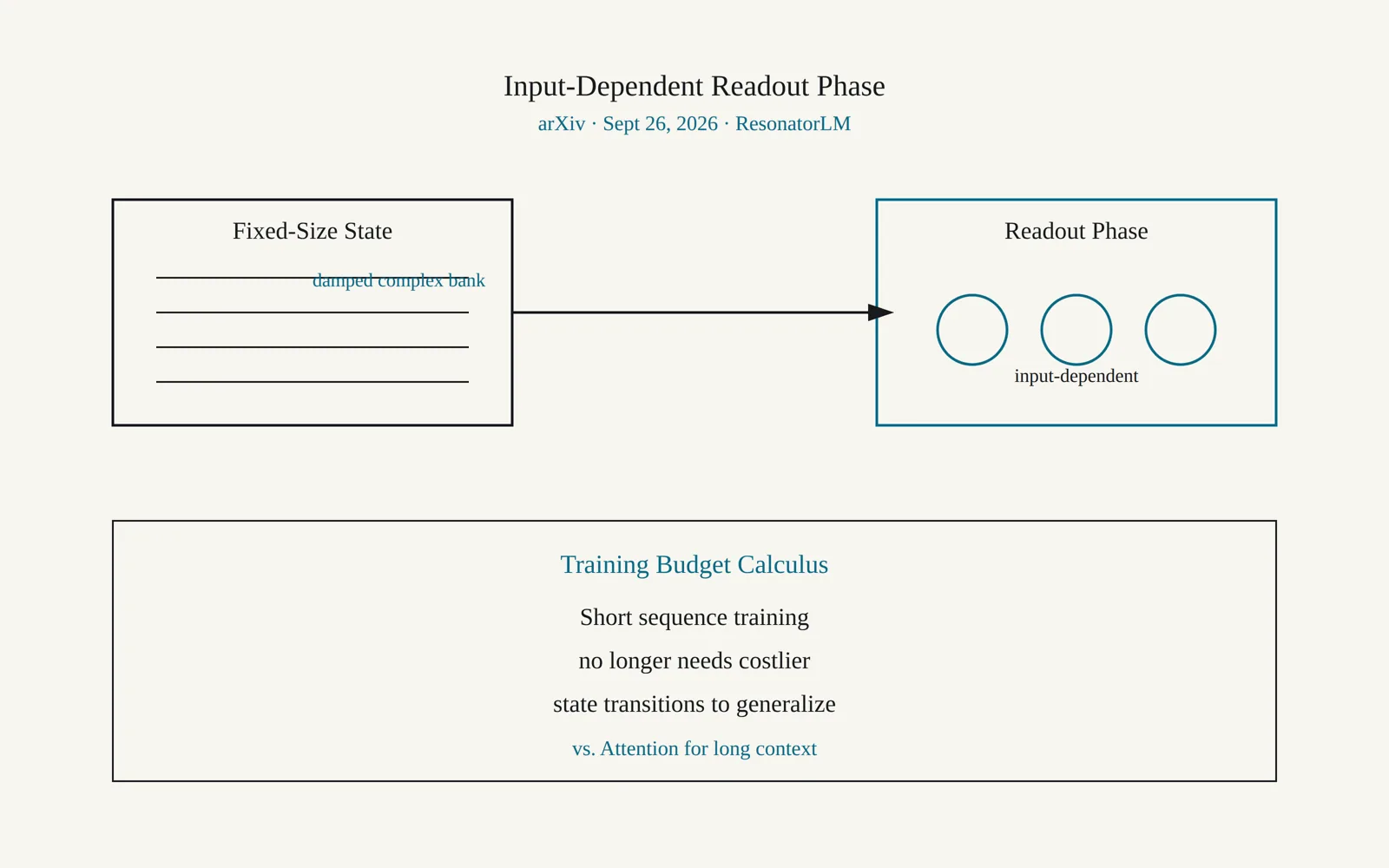
Diagram drawn for this item: Paper Adds Input-Dependent Readout Phase To Resonant Sequence Models. On September 26, 2026, a paper titled An Input-Dependent Readout Phase for Resonant Sequence Models was submitted to arXiv, describing a change to ResonatorLM, a fixed-size state sequence model that reads a bank of damped complex... For anyone weighing a fixed-state sequence model against attention for long context work, the result changes the training budget calculus: a model trained on a shorter sequence no longer needs a costlier state transition just to stay...
The numbers
Extra parameters
0.2 percent
Added by making the readout phase a function of the current token
Perplexity, original phase
12.81
6M-parameter character-level model on WikiText-2, trained on 256 tokens, tested on 1024
Perplexity, input-dependent phase
3.76
Same test, with the new token-dependent readout phase
What it means for you
For anyone weighing a fixed-state sequence model against attention for long context work, the result changes the training budget calculus: a model trained on a shorter sequence no longer needs a costlier state transition just to stay usable once deployed at roughly four times that length, which lowers the retraining bill a team faces when it decides to extend a context window rather than rebuild the whole architecture. That tradeoff matters because it separates the cost of training from the cost of serving, letting a team keep the cheap convolutional path at inference while only paying the small parameter tax once, at training time.
In more detail
A new paper posted to arXiv on September 26, 2026 addresses a design choice that sits under every sequence model built to avoid the quadratic cost of attention. Such models keep a fixed-size state rather than growing one with the sequence, and the state can be updated either with an input-dependent transition, which gives content-dependent memory but forces slower FFT-based training, or with a fixed transition, which keeps a fast convolutional training path but reads memory the same way regardless of what the model has seen. ResonatorLM, a recent model of the second kind, reads a bank of damped complex oscillators through a phase that is learned once per head and then fixed.
The paper, by Shivesh Rane, modifies only the read step. The phase that reads the oscillator bank becomes a function of the current token rather than a fixed per-head value, which adds input dependence without touching the state transition itself, so the exact convolutional training path survives unchanged. The authors report the change costs 0.2 percent more parameters.
An analysis of the untrained oscillator bank found that its phase does encode elapsed time, but an ordinary token’s signal falls below background noise within 2 to 8 steps, and no choice of damping extended linear reconstruction of position past roughly 16 tokens, a ceiling the fixed phase cannot escape on its own.
The numbers
Tested on 6M-parameter character-level models trained on WikiText-2 with a training length of 256 tokens, the original fixed phase matched the new input-dependent phase on sequences at that training length but broke down once evaluated on 1024-token sequences, where perplexity reached 12.81. The input-dependent phase, evaluated at the same 1024-token length, brought perplexity down to 3.76. The authors trace the original failure to long-memory heads that accumulate more history at test time than they were exposed to during training, and note that the learned phase tracks the current character rather than distance, which is why it does not improve retrieval even as it fixes the length generalization problem. The result separates two properties that are often bundled together in fixed-state sequence models: how well a model generalizes to a longer sequence than it trained on, and how well it can retrieve something from far back in that sequence.
Sources
Sources read
Cite this
AI Journey, "Paper Adds Input-Dependent Readout Phase To Resonant Sequence Models", 12 Oct 2026, https://aijourney.space/updates/2026-10-12-an-input-dependent-readout-phase-for-resonant-sequence-models/ (source: arXiv, verified 12 Oct 2026)
Next in the stream
xAI Changes Grok Pricing Page at grok.com
xAI's public site at grok.com now shows a pricing page that differs from the version this site last recorded, though the vendor has not detailed the change.
Previous
Google Showcases Four Developer Builds Made With Gemini 3.8 Flash
Google published a roundup of four developer projects built with Gemini 3.8 Flash, the workhorse model it priced into the API this month.
Next
More in Perplexity AI
Perplexity AI Researchers Detail LoRA Recipe For Converting Four Language Models To Diffusion
A paper associated with Perplexity AI describes BYOD, a LoRA-only method that converts standard autoregressive language models into diffusion language models without full retraining.
Paper Proposes Message-Passing Method For Compressing LLM Weights
A new arXiv paper proposes a message-passing method for compressing large language model weights, the kind of efficiency work that underlies answer engines like Perplexity AI.
Researchers Publish S-SALAAD Framework For Sparse Large Model Inference
A new paper on compressing large models for edge devices matters to Perplexity AI and any company whose answer engine has to run inference away from a data center.