What happened
Published here
On October 13, 2026, researchers Yiheng Su, Junyi Jessy Li and Matthew Lease posted a paper on arXiv describing DualView, a parameter-efficient method for multi-output text regression that extracts broad and output-specific evidence from a frozen large language model, and reported that DualView using a smaller open-weight model outperformed unsupervised prediction with Google's Gemini 3.1 Pro across several heterogeneous regression tasks. (arXiv abstract page for DualView, posted 13 October 2026)
Open the photograph at full size
Photograph: Diagram: AI Journey
Read the full description of this diagram
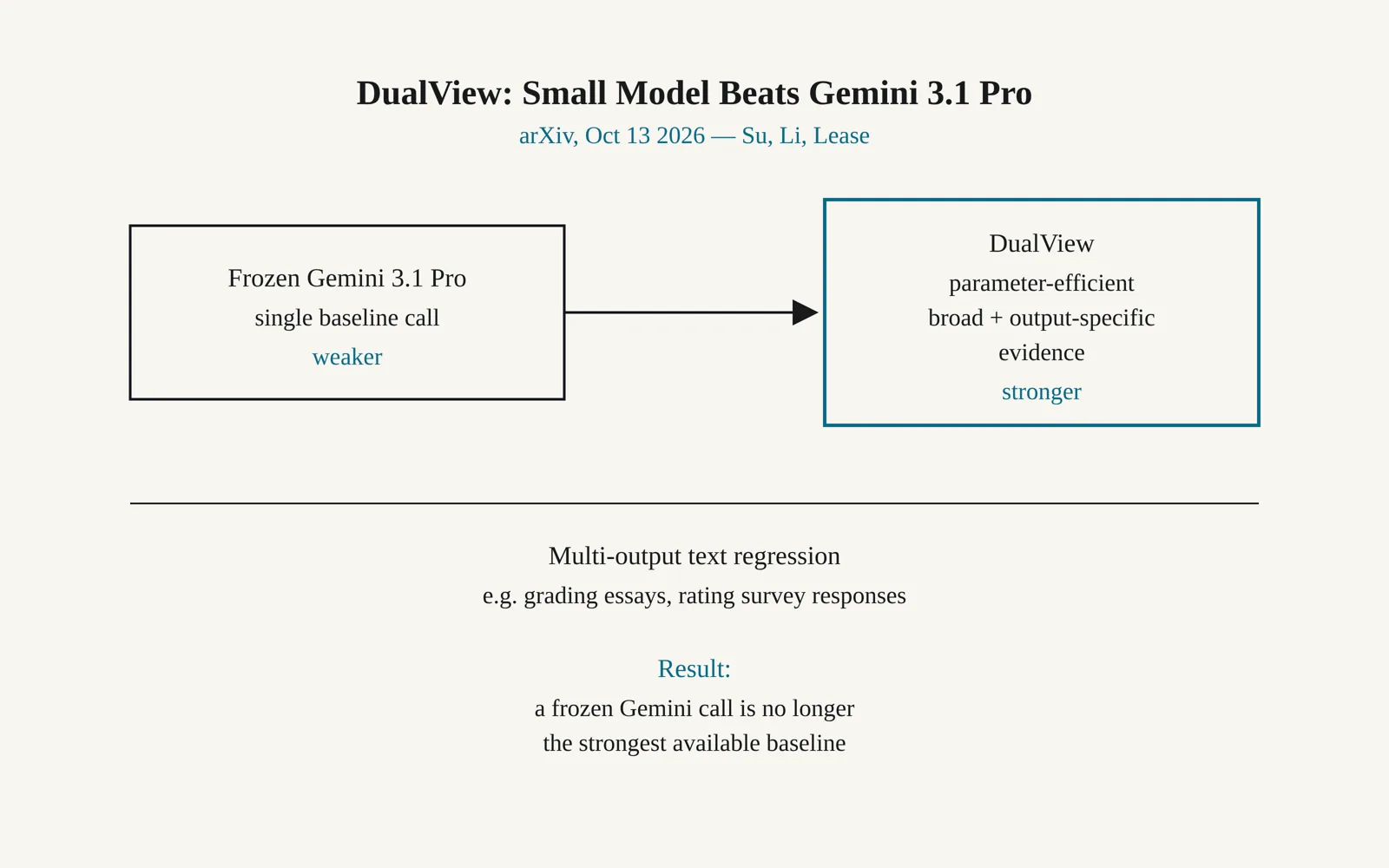
Diagram drawn for this item: Paper Shows Small Open Model Outperforming Gemini 3.1 Pro. On October 13, 2026, researchers Yiheng Su, Junyi Jessy Li and Matthew Lease posted a paper on arXiv describing DualView, a parameter-efficient method for multi-output text regression that extracts broad and output-specific evidence from a... For teams that score text on several dimensions at once, such as grading essays or rating survey responses, the result means a frozen Gemini call is no longer the strongest baseline on offer.
What it means for you
For teams that score text on several dimensions at once, such as grading essays or rating survey responses, the result means a frozen Gemini call is no longer the strongest baseline on offer. A smaller open-weight model trained with this dual-branch method can match or beat Gemini's unsupervised output while fitting far fewer parameters, which changes the calculus for anyone weighing a per-token API bill against hosting a compact model themselves.
In more detail
The paper, titled “DualView: Leveraging Broad and Output-Specific Evidence for LLM-based Multi-Output Text Regression,” addresses a problem that has gotten less attention than single-number prediction: scoring a piece of text on more than one axis at once, such as rating an essay for grammar, argument strength and clarity in a single pass. The authors present DualView, which pulls two kinds of representation out of a frozen large language model, a broad reading of the whole text and an output-specific reading tuned to each score the system needs to produce, then combines them through a dual-branch architecture to generate the full vector of scores together.
The authors tested DualView across five heterogeneous regression tasks and eight large language models, including one with 122 billion parameters, and compared it against seven supervised regression baselines. They report that DualView beat all seven while fitting far fewer parameters than the three strongest of those baselines. The gains held up when the researchers looked at individual output dimensions separately rather than only at aggregate scores, and the method kept its advantage even when training data was scarce.
The detail most relevant to this site is the comparison with Gemini. The paper states that DualView, when built on a smaller open-weight language model, outperformed unsupervised prediction carried out with Gemini 3.1 Pro. That is a narrow claim: it covers unsupervised use of Gemini specifically, not every way Gemini could be deployed for the task, and the authors frame it as evidence that a lightweight, tuned approach on a smaller model can beat a larger general-purpose model that has had no task-specific adaptation applied to it.
The numbers
The paper’s headline architecture detail is its scale: the largest language model tested in the comparison carried 122 billion parameters, the size the authors print to establish how far up the model-size ladder their method was checked. Ablations in the paper further show that the broad and output-specific branches contribute separately rather than overlapping, and that lightweight shared predictors can reach strong results with comparatively few trainable parameters, reinforcing the efficiency claim at the center of the work.
For anyone currently routing text-scoring workloads through the Gemini API by default, the paper is a reminder that an unsupervised general-purpose call is not automatically the strongest or cheapest option once a dedicated, smaller method is fitted to the specific scoring task.
Sources
Sources read
arXiv abstract page for DualView, posted 13 October 2026 (arxiv.org)
Paper read
Cite this
AI Journey, "Paper Shows Small Open Model Outperforming Gemini 3.1 Pro", 15 Oct 2026, https://aijourney.space/updates/2026-10-15-dualview-leveraging-broad-and-output-specific-evidence-for-llm-based-mul/ (source: arXiv, verified 15 Oct 2026)
Next in the stream
Academic Benchmark Finds Google's Gemini 2.5 Flash Leads Bengali Factuality
A new academic benchmark testing eight language models found Google's Gemini 2.5 Flash scored highest for factual accuracy in Bengali summaries.
Previous
Researchers Detail Sparse Attention Method Tested on Nvidia B200
A new paper tested on Nvidia's B200 GPU describes a sparse attention method aimed at cutting long-context decoding costs without retraining a model.
Next
More in Google
Google.org Funds Five Groups Building AI Tools For Teachers
Google.org is funding five organizations building AI tools for teachers, pairing Google DeepMind's model work with grants aimed at classroom use.
Gemini Negotiation Paper Finds Persona Effects Shift By Language
A new paper testing Google's Gemini model in buyer-seller negotiations found that the same persona instruction produced different deal outcomes in English and Korean.
Paper Finds Gemini Monitor Beats Small Models At Spotting Reward Hacking
A new paper tests whether Google's Gemini 3.1 Flash-Lite can tell real reward hacking apart from honest failure better than small local monitors.