What happened
Published here
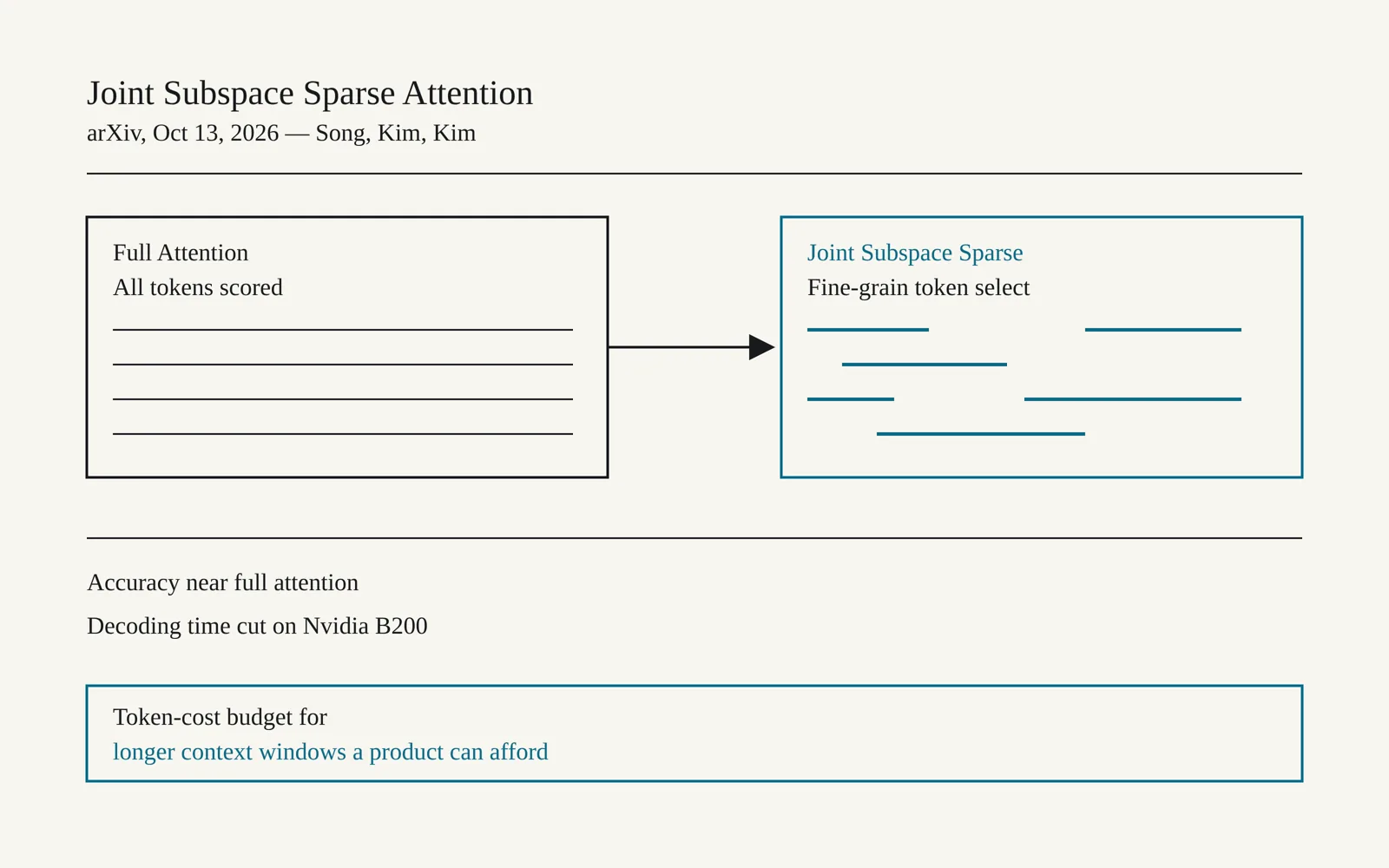
On October 13, 2026, researchers Jiwon Song, Yoongon Kim and Jae-Joon Kim posted a paper on arXiv describing Joint Subspace Sparse Attention, a method for long-context decoding that selects tokens at a fine grain while avoiding the gathering step that normally eats into any latency gain, and reported throughput results measured on an Nvidia B200 GPU. (arXiv preprint, Joint Subspace Sparse Attention for Efficient Long-Context Decoding, posted October 13, 2026)
Open the photograph at full size
Photograph: Diagram: AI Journey
Read the full description of this diagram
Diagram drawn for this item: Researchers Detail Sparse Attention Method Tested on Nvidia B200. On October 13, 2026, researchers Jiwon Song, Yoongon Kim and Jae-Joon Kim posted a paper on arXiv describing Joint Subspace Sparse Attention, a method for long-context decoding that selects tokens at a fine grain while avoiding the... For a team paying by the token for long-context inference, a sparse attention scheme that holds accuracy near full attention while cutting decoding time changes the budget math for the context window a product can afford to offer, not just...
What it means for you
For a team paying by the token for long-context inference, a sparse attention scheme that holds accuracy near full attention while cutting decoding time changes the budget math for the context window a product can afford to offer, not just the model it chooses.
In more detail
The paper addresses a cost that shows up whenever a language model has to hold a long conversation or document in context: the key-value cache that decoding reads from grows with every token, and reading it becomes the main thing slowing generation down. Sparse attention tries to cut that cost by skipping over tokens that matter less to the next prediction, but the authors argue most existing methods pick which tokens to skip in blocks that are too coarse, or they pick individual tokens in a way that loses the structure needed to rank them accurately.
Their method, called Joint Subspace Sparse Attention, learns a shared low-dimensional space for queries and keys that preserves token-level scoring accuracy, solved with a closed-form spectral approach rather than an iterative one. The authors state plainly that trying to refine the harder, non-convex version of this problem directly gave no measurable improvement in their tests, which is a useful admission: it says the simpler, tractable approximation was not a compromise they settled for, but one they checked and found sufficient.
The second half of the work is about execution rather than selection. Picking scattered tokens from memory is itself slow if the hardware has to gather them one at a time, so the team built what they call a gather-free, token-level indexed attention kernel that works with the grouped-query attention layout most production models already use. They tested the combined method across three different attention architectures, including models using multi-head latent attention, and report that it stays close to full-attention accuracy in each case while avoiding the generation-length inflation that competing sparse methods showed in their tests.
The numbers
Run on an Nvidia B200 GPU at a 128K token context length, the method reached up to 6.43x the decoding throughput of full attention. At the scale of a 700 billion parameter model, the authors report the method reaches 96 to 99 percent of the decoding throughput of a sparse attention mechanism built directly into the model’s own architecture, while matching that native method’s reasoning accuracy without any additional training.
That last comparison is the one worth sitting with. A sparse attention mechanism trained into a model from the start has an obvious advantage: the model learned around it. A method that reaches most of that speed without touching the model’s weights is a tool that could, in principle, be applied after the fact to models already in production, which matters more to a team running inference at scale than to one training a new model from scratch.
Sources
Sources read
Cite this
AI Journey, "Researchers Detail Sparse Attention Method Tested on Nvidia B200", 16 Oct 2026, https://aijourney.space/updates/2026-10-16-joint-subspace-sparse-attention-for-efficient-long-context-decoding/ (source: arXiv, verified 16 Oct 2026)
Next in the stream
Paper Shows Small Open Model Outperforming Gemini 3.1 Pro
A new paper describes DualView, a text regression method whose smaller open weight language model outperformed unsupervised prediction with Google's Gemini 3.1 Pro.
Previous
Paper Finds Agent Harnesses Do Not Reliably Improve Reasoning Accuracy
A new preprint introduces AlphaDiana, a measurement system that tests whether agent harnesses, memory and skill instructions actually raise reasoning accuracy.
Next
More in Nvidia
Nvidia RTX Spark Laptops Add Transcription Model and New Game Support
Nvidia detailed new RTX Spark laptop updates, including a transcription model from its Nemotron line and support for Liquid AI's LFM3 models.
Nvidia Launches Minerva Platform for AI Factory Observability
Nvidia introduced Minerva, an AIOps platform that merges infrastructure and workload telemetry to flag problems across AI factories before they spread.
Nvidia Expands Agent Toolkit With Data Grounding Tools
Nvidia expanded its open source Agent Toolkit on October 21, 2026, adding an Agent Knowledge Foundation that grounds enterprise agents in company data without moving it.