Event Published ResearchResearch
Paper Finds Agent Harnesses Do Not Reliably Improve Reasoning Accuracy
A new preprint introduces AlphaDiana, a measurement system that tests whether agent harnesses, memory and skill instructions actually raise reasoning accuracy.
What happened
Published here
A paper titled AlphaDiana: A Measurement System for Agents in Verifiable Reasoning Tasks was submitted to arXiv on October 14, 2026, describing a system for measuring how agent harnesses, tool use, skill instructions and memory retention affect reasoning model performance across several open-source benchmarks. (arXiv preprint, AlphaDiana: A Measurement System for Agents in Verifiable Reasoning Tasks, submitted October 14, 2026)
Open the photograph at full size
Photograph: Diagram: AI Journey
Read the full description of this diagram
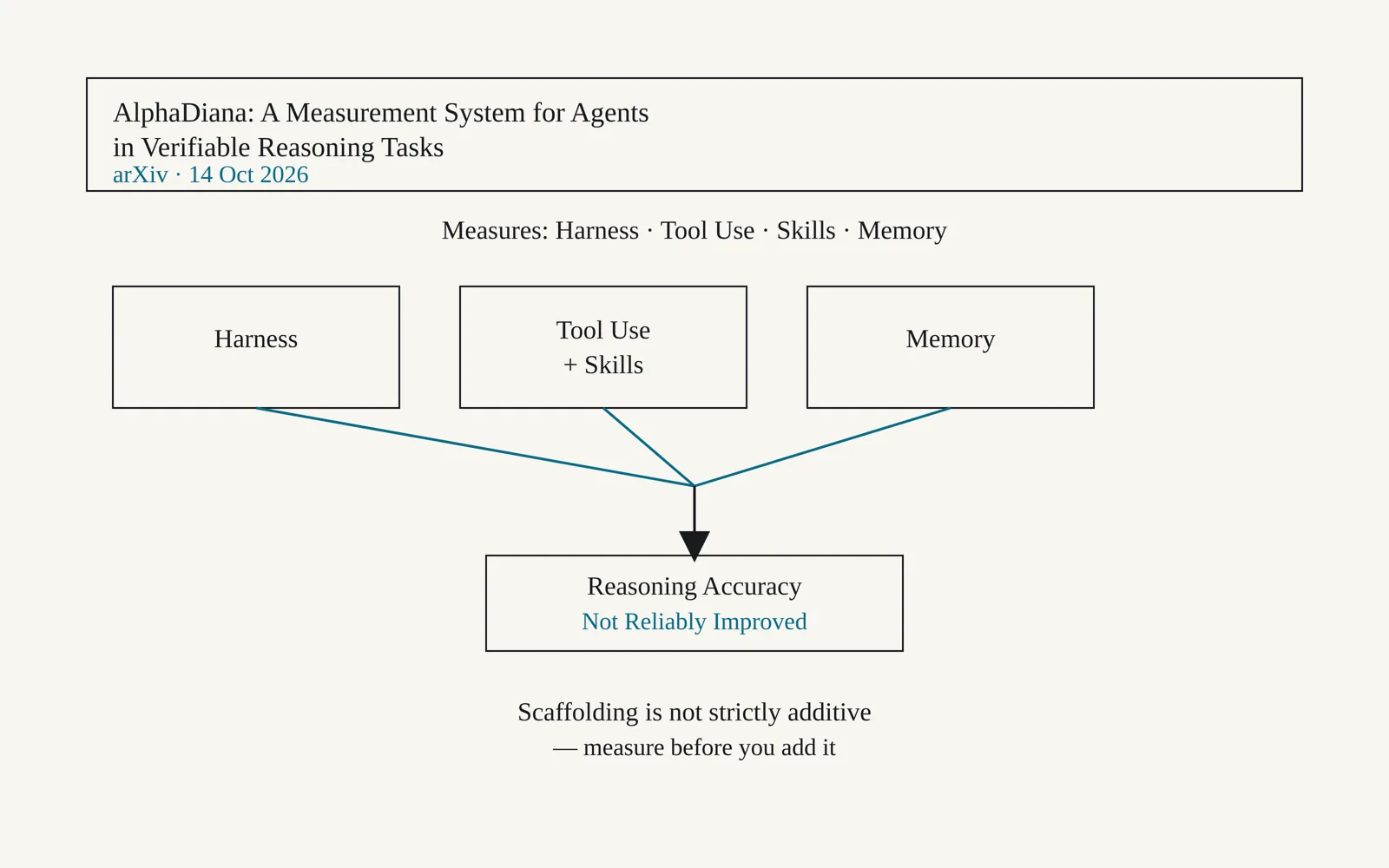
Diagram drawn for this item: Paper Finds Agent Harnesses Do Not Reliably Improve Reasoning Accuracy. A paper titled AlphaDiana: A Measurement System for Agents in Verifiable Reasoning Tasks was submitted to arXiv on October 14, 2026, describing a system for measuring how agent harnesses, tool use, skill instructions and memory retention... For a team deciding whether to wrap a reasoning model in a harness, add tool calls, or feed it retained memory, the finding cuts against the default assumption that more scaffolding is strictly additive.
What it means for you
For a team deciding whether to wrap a reasoning model in a harness, add tool calls, or feed it retained memory, the finding cuts against the default assumption that more scaffolding is strictly additive. Gains on questions a model could not answer alone were offset by losses on questions it already answered correctly without tools, which turns adopting a harness into a bet that has to be checked case by case rather than treated as a safe upgrade, and it means token spend per correct answer can rise even when total output shrinks.
In more detail
Researchers led by Zhanke Zhou and eighteen co-authors published a preprint describing AlphaDiana, a measurement system built to answer a question that agent builders usually assume rather than test: does wrapping a reasoning model in a harness, adding tools, loading skill instructions or retaining memory actually make it more accurate. The paper, posted to arXiv on October 14, 2026, argues that the answer is not a simple yes.
AlphaDiana separates the parts of an agent that are usually bundled together. It keeps each harness’s own control loop intact while giving researchers modular interfaces to swap datasets, environments, scorers and agent components independently, so a change in memory retention can be measured without also changing file reuse or tool access. The system supports both macro comparisons of complete agents and micro interventions on a single component, under matched conditions, which the authors say is needed to tell whether a gain came from the harness itself or from an unrelated change in setup.
The headline result is that harnesses do not consistently raise accuracy. On some questions a model could not answer alone, a harness produced a correct answer. But on other questions the same model already answered correctly without any tools, and the harness introduced a wrong answer instead. Across the benchmarks tested, those losses sometimes outweighed the gains, so a harness that looks like a net improvement on one measure can be a net loss once both directions are counted together. The same pattern held for narrower interventions: neither adding skill guidance nor retaining conversation history reliably improved accuracy on its own.
The authors also flag a measurement trap in how teams read agent behavior. Low token entropy, often read as a sign of a confident, well-calibrated agent, can still accompany a wrong answer. And when accuracy falls, an agent can produce fewer output tokens overall while needing more output tokens for each answer it actually gets right, so a shrinking token budget does not necessarily mean a cheaper correct answer.
The numbers
The study evaluated three open-source reasoning models against three open-source agent harnesses, run across five answer-based benchmarks. Two of those models were tested further on two interactive benchmarks, giving the authors both static question-answering tasks and settings where the agent has to act over several turns. AlphaDiana logs correctness and execution status alongside full traces and resource records for every run, which is what lets the paper compare harnesses and diagnose failures under matched task and resource conditions rather than from end results alone.
Sources
Sources read
Cite this
AI Journey, "Paper Finds Agent Harnesses Do Not Reliably Improve Reasoning Accuracy", 17 Oct 2026, https://aijourney.space/updates/2026-10-17-alphadiana-a-measurement-system-for-agents-in-verifiable-reasoning-tasks/ (source: arXiv, verified 17 Oct 2026)
Next in the stream
Researchers Detail Sparse Attention Method Tested on Nvidia B200
A new paper tested on Nvidia's B200 GPU describes a sparse attention method aimed at cutting long-context decoding costs without retraining a model.
Previous
Paper Proposes Three-Tier Access Model For Frontier AI Systems
A new paper posted to arXiv proposes sorting who may use a capable AI system into three tiers by purpose, safety and capability, separate from how capable the system itself may become.
Next
More in Research
Study Finds Precedent Labels Sway Claude Haiku Approval Calls
A new paper tests Claude Haiku 5.5 alongside other models on refund and claim decisions, showing that past case labels shift approvals sharply.
Paper Tests Claude Opus 4.8 Agents on Conflicting Code Edits
A new paper benchmarks Claude Code running Claude Opus 4.8 against other coding agents on tasks where two agents edit the same shared codebase at once.
Perplexity AI Researchers Detail LoRA Recipe For Converting Four Language Models To Diffusion
A paper associated with Perplexity AI describes BYOD, a LoRA-only method that converts standard autoregressive language models into diffusion language models without full retraining.