Event Published ResearchResearch
Paper Proposes Three-Tier Access Model For Frontier AI Systems
A new paper posted to arXiv proposes sorting who may use a capable AI system into three tiers by purpose, safety and capability, separate from how capable the system itself may become.
What happened
Published here
On October 14, 2026, researchers Chai K. Toh and Vasu Raj Jain posted a paper to arXiv describing a Multi-Tiered AI Accessibility Model, called MAIAM, that separates the decision of how capable a system may become from a second, distinct decision about who may obtain a given capability and on what terms, and groups that second decision into three tiers. (arXiv preprint 2610.20921, submitted 14 October 2026)
Open the photograph at full size
Photograph: Diagram: AI Journey
Read the full description of this diagram
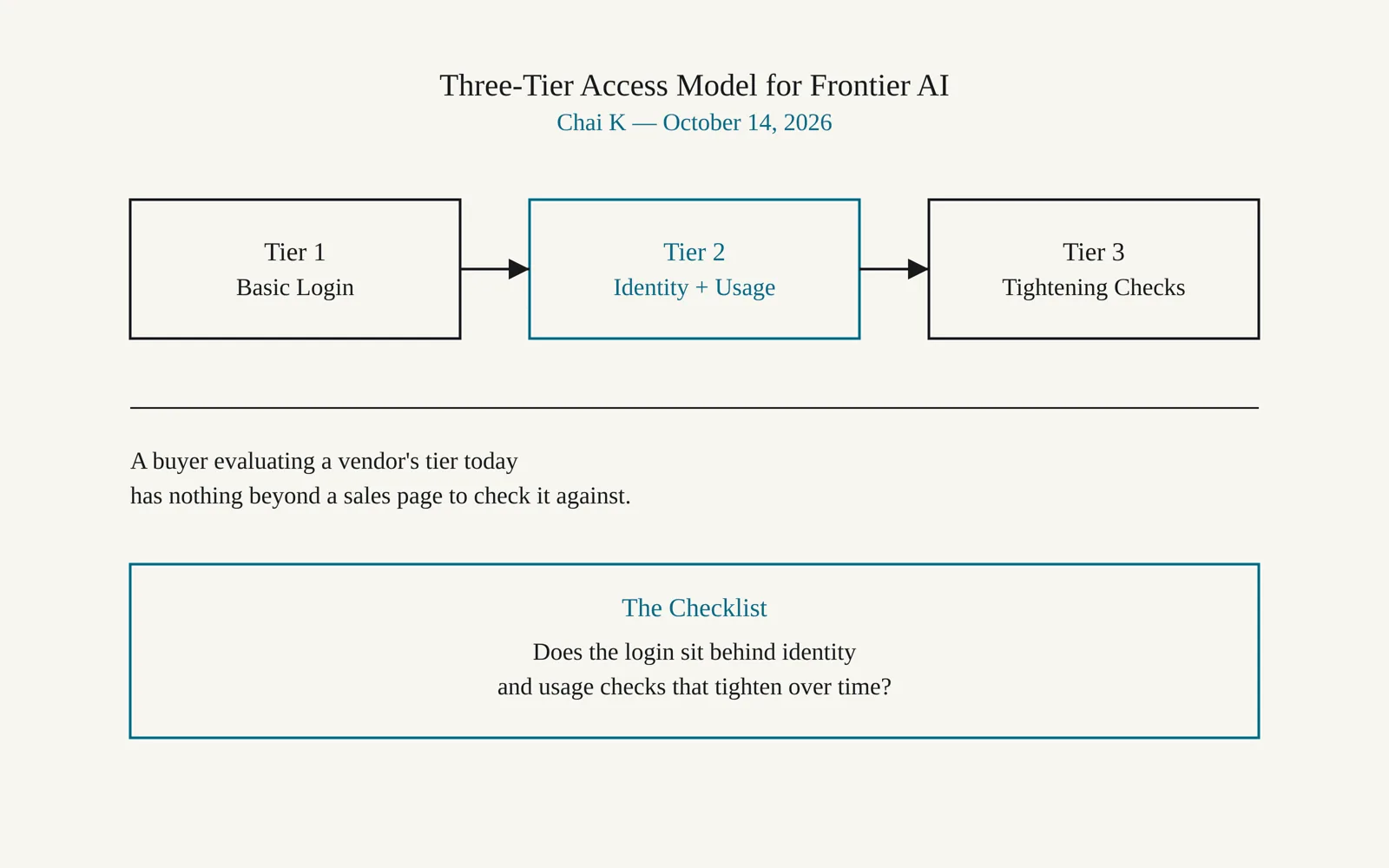
Diagram drawn for this item: Paper Proposes Three-Tier Access Model For Frontier AI Systems. On October 14, 2026, researchers Chai K. A buyer evaluating a vendor's access tier today has almost nothing to check it against beyond a sales page; this framework gives that buyer a checklist, asking whether a login actually sits behind identity and usage checks that tighten...
What it means for you
A buyer evaluating a vendor's access tier today has almost nothing to check it against beyond a sales page; this framework gives that buyer a checklist, asking whether a login actually sits behind identity and usage checks that tighten with capability, or whether a tier label is just marketing dressed as a safety control. For a procurement team weighing an open weights download against an API seat, the paper reframes the choice from a single yes or no decision into two separate questions worth pricing out separately, one about what the model can do and one about who is allowed to reach it.
In more detail
A new preprint argues that the usual debate over releasing capable AI systems collapses two separate questions into one. Most arguments treat release as a binary: either a model sits behind an API that a company controls, or its weights are published for anyone to download and run. The paper’s authors, Chai K. Toh and Vasu Raj Jain, say that framing conflates how capable a system is allowed to become with who is allowed to obtain that capability and under what conditions. Their proposed Multi-Tiered AI Accessibility Model, MAIAM, treats those as two separate design choices rather than one release decision.
MAIAM sorts access into three tiers. Tier 1, called AI for Learning, is broadly open to the public but deliberately bounded in what it can do. Tier 2, AI for Exploration, serves research and development work under registration, identity checks and usage controls that the paper says tighten as the underlying capability rises. Tier 3, Full-Scale Frontier AI, is reserved for structured, recorded and accountable access, the kind a lab or a vetted institution might get rather than an anonymous account.
The study pairs this tiering with what it calls a Capability Boundary, a fixed ceiling on how dangerous a system’s abilities may be, and an Accessibility Boundary, a separate line governing who may reach a capability below that ceiling. The authors argue the two boundaries have to work together: a capability limit alone, with no control over who can obtain it, still leaves the door open to misuse once weights are out in the world.
The numbers
The paper’s central evidence concerns what happens once weights leave a developer’s hands. It cites findings that safety fine-tuning built into an open-weight model can be stripped out for a few hundred dollars, which the authors use to argue that evaluating a base model tells a regulator little about what its derivatives will do once that tuning is removed. The access model itself rests on four criteria for assigning a system to a tier: capability, autonomy, the consequence of its application domain, and usage or safety history. Named alongside the tiers and the two boundaries, those axes make up the full proposal, which the authors present as a checklist for placing any given system rather than a one-off judgment call.
The paper stops short of naming which regulator or company should administer the tiers, leaving that as a governance question for others to take up. Its contribution is the structure itself: a reader evaluating a vendor’s release plan now has a named framework for asking whether access controls, not just capability limits, are doing any of the safety work.
Sources
Sources read
arXiv preprint 2610.20921, submitted 14 October 2026 (arxiv.org)
Paper read
Cite this
AI Journey, "Paper Proposes Three-Tier Access Model For Frontier AI Systems", 17 Oct 2026, https://aijourney.space/updates/2026-10-17-a-multi-tiered-ai-accessibility-model-maiam-proportionate-access-and-cap/ (source: arXiv, verified 17 Oct 2026)
Next in the stream
Paper Finds Agent Harnesses Do Not Reliably Improve Reasoning Accuracy
A new preprint introduces AlphaDiana, a measurement system that tests whether agent harnesses, memory and skill instructions actually raise reasoning accuracy.
Previous
Google Adds Gemini 4 Argon Access To Paid Gemini Subscriptions
Google's Gemini subscription page now promotes Gemini 4 Argon access for AI Pro and AI Ultra subscribers, with plan prices unchanged from the prior structure.
Next
More in Research
Study Finds Precedent Labels Sway Claude Haiku Approval Calls
A new paper tests Claude Haiku 5.5 alongside other models on refund and claim decisions, showing that past case labels shift approvals sharply.
Paper Tests Claude Opus 4.8 Agents on Conflicting Code Edits
A new paper benchmarks Claude Code running Claude Opus 4.8 against other coding agents on tasks where two agents edit the same shared codebase at once.
Perplexity AI Researchers Detail LoRA Recipe For Converting Four Language Models To Diffusion
A paper associated with Perplexity AI describes BYOD, a LoRA-only method that converts standard autoregressive language models into diffusion language models without full retraining.