What happened
Published here
On October 19, 2026, researchers posted EGI-BENCH to arXiv, a benchmark suite that consolidates eight separate enterprise agent benchmarks behind one command line interface and scores fourteen frontier and cost efficient models, including Claude Sonnet 4.5 and Claude Haiku 4.5, under a single runtime budgeted test run. (EGI-BENCH paper on arXiv, submitted October 19, 2026)
Open the photograph at full size
Photograph: Diagram: AI Journey
Read the full description of this diagram
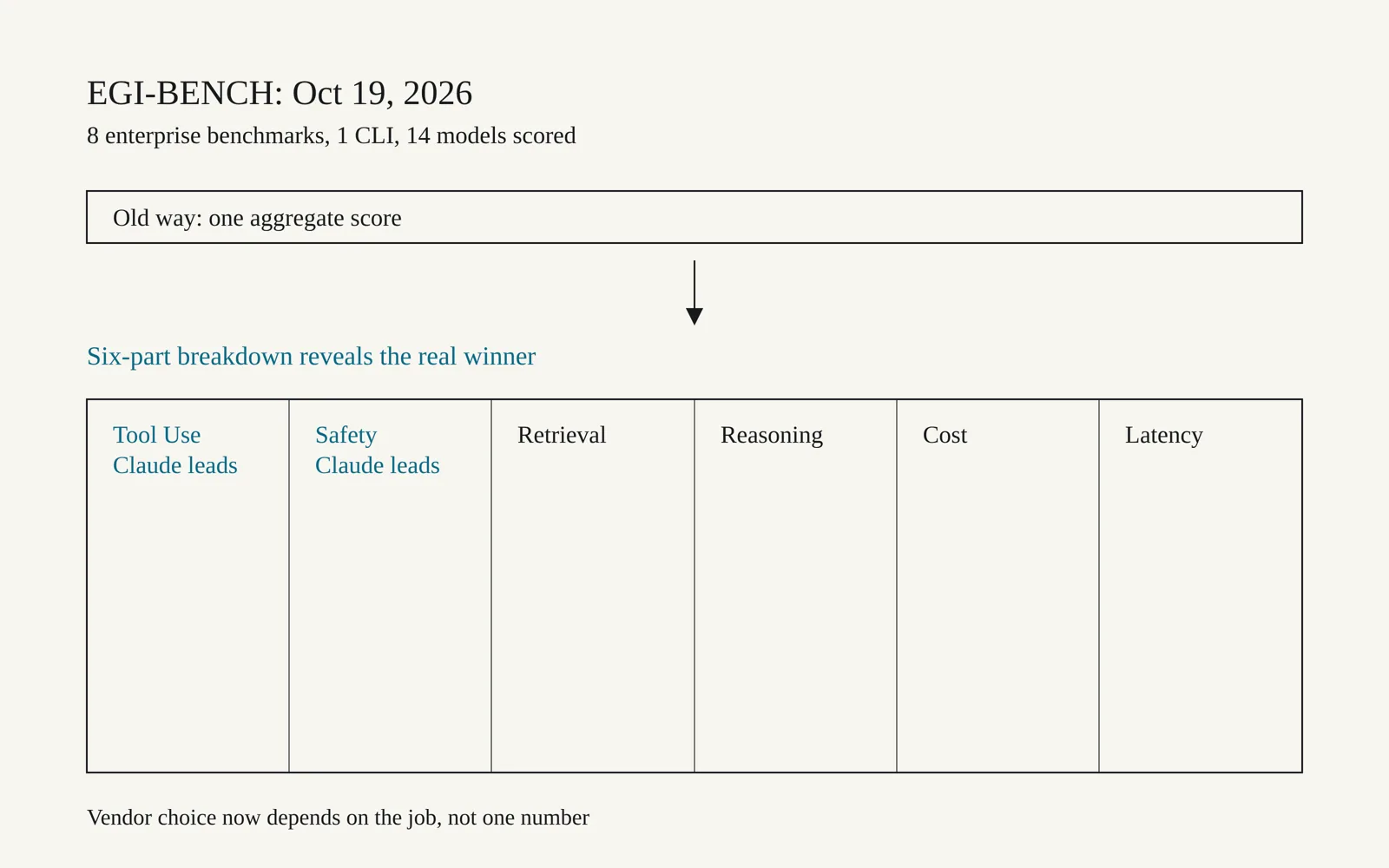
Diagram drawn for this item: New EGI-BENCH Suite Scores Claude Models Against GPT and Gemini. On October 19, 2026, researchers posted EGI-BENCH to arXiv, a benchmark suite that consolidates eight separate enterprise agent benchmarks behind one command line interface and scores fourteen frontier and cost efficient models, including... For a company choosing which model runs its support queue or its document retrieval pipeline, a single aggregate score has hidden which vendor actually wins which job, so a six part breakdown that names Claude ahead on tool use and safety...
The numbers
Lowest EGI score
39.6
GPT-4o mini's top-line Enterprise General Intelligence score
Highest EGI score
65.6
gpt-5.5's top-line Enterprise General Intelligence score
Read from EGI-BENCH paper on arXiv, submitted October 19, 2026
What it means for you
For a company choosing which model runs its support queue or its document retrieval pipeline, a single aggregate score has hidden which vendor actually wins which job, so a six part breakdown that names Claude ahead on tool use and safety abstention while another model leads planning gives a procurement team a reason to split work across vendors rather than standardize on one.
In more detail
Researchers from Salesforce AI Research published EGI-BENCH, a benchmark suite built to answer a narrower, more practical question than most agent leaderboards attempt: which model should a company actually run for a given enterprise workflow. The suite folds eight existing agent benchmarks, CRMARENA, HERB, PERSONABENCH, USERBENCH, MCP-UNIVERSE, MCPEVAL, BENCHFORCE and LOCOBENCH, behind one command line interface, replacing the separate runners, dependencies and scoring conventions each had previously used. On top of that consolidated suite, the authors define an Enterprise General Intelligence score built from six dimensions, labeled M1 through M6, each populated by fine grained sub-metrics routed from the underlying benchmarks rather than by averaging whole benchmark scores together.
The paper reports results for fourteen models spanning the GPT, Claude and Gemini families, run under the suite’s quick, runtime budgeted mode. The authors found that no single model wins across every capability axis. GPT-5.5 leads on task outcome, planning and retrieval grounding, while Claude Sonnet 4.5 leads on tool actioning and on safety and abstention, and Claude Haiku 4.5 leads on engineering quality. That spread is the paper’s central claim: an aggregate ranking collapses distinctions that matter once a buyer is choosing a model for one specific job rather than for everything at once.
The numbers
Top-line EGI scores across the fourteen tested models ranged from 39.6, posted by GPT-4o mini, up to 65.6, posted by gpt-5.5. The suite reports each model’s performance separately on the six underlying dimensions rather than folding them into one number, which is how the paper surfaces Claude Sonnet 4.5’s lead on tool actioning and safety abstention even though it does not top the overall ranking.
For teams building agentic workflows around CRM operations, document retrieval or long-context software engineering, the paper’s own framing is a caution against buying on a single leaderboard position. A model that trails on an aggregate score can still be the better choice for a workflow that depends heavily on the one dimension it leads, and the suite’s unified runner is built specifically so that comparison can be made without rerunning eight separate benchmark repositories by hand.
Sources
Sources read
EGI-BENCH paper on arXiv, submitted October 19, 2026 (arxiv.org)
Paper read
Cite this
AI Journey, "New EGI-BENCH Suite Scores Claude Models Against GPT and Gemini", 21 Oct 2026, https://aijourney.space/updates/2026-10-21-egi-bench-an-enterprise-general-intelligence-benchmark-suite/ (source: arXiv, verified 21 Oct 2026)
Next in the stream
Nvidia RTX Spark Laptops Go On Sale From $2,399
Nvidia marked the retail arrival of its RTX Spark laptops with launch events worldwide, as partner Windows PCs built around the new chip reached buyers.
Previous
Google Adds Business Hub And Tools To Gemini App
Google added a dedicated small business landing page to the Gemini app, bundling branding, finance and app connections into one hub.
Next
More in Anthropic
Study Finds Precedent Labels Sway Claude Haiku Approval Calls
A new paper tests Claude Haiku 5.5 alongside other models on refund and claim decisions, showing that past case labels shift approvals sharply.
Paper Tests Claude Opus 4.8 Agents on Conflicting Code Edits
A new paper benchmarks Claude Code running Claude Opus 4.8 against other coding agents on tasks where two agents edit the same shared codebase at once.
Paper Finds Claude Opus 5.5 Agent Beats Automated CT Labeling Harness
A new paper testing CT scan labeling finds a free-form agent running Claude Opus 5.5 outscored an automated review harness on most of six public datasets.