What happened
Published here
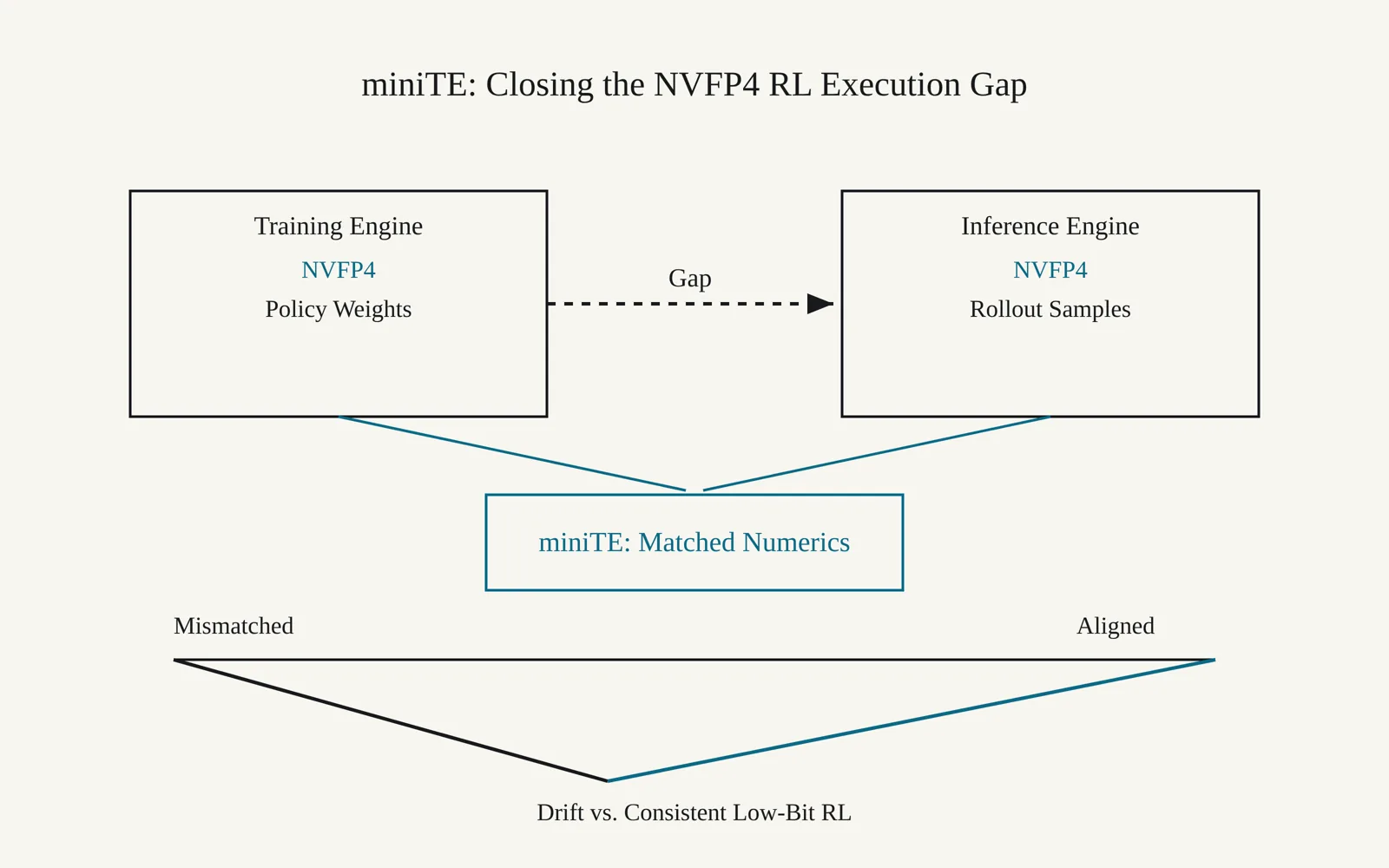
On October 7, 2026, researchers published a paper on arXiv describing miniTE, a lightweight framework addressing a numerical consistency gap that appears when reinforcement learning for large language models runs natively on Nvidia's NVFP4 4-bit format across separate training and sampling engines, with experiments reported on the Qwen3-30B-A3B model and a single Nvidia B300 GPU node. (arXiv abstract page for miniTE, submitted October 7, 2026)
Open the photograph at full size
Photograph: Diagram: AI Journey
Read the full description of this diagram
Diagram drawn for this item: Paper Details Fix For Execution Gap In Nvidia's NVFP4 Training. On October 7, 2026, researchers published a paper on arXiv describing miniTE, a lightweight framework addressing a numerical consistency gap that appears when reinforcement learning for large language models runs natively on Nvidia's NVFP4... For teams weighing whether to move reinforcement learning jobs onto 4-bit precision, the gap this paper closes changes a real choice: without matching numerical execution across engines, a cheaper low-bit run can silently drift from the...
The numbers
Learner throughput
33,540 tokens/s
On a single Nvidia B300 GPU node
Speedup over BF16
1.39x
Speedup over prior NVFP4
1.47x
Versus naive Transformer Engine NVFP4
Read from arXiv abstract page for miniTE, submitted October 7, 2026
What it means for you
For teams weighing whether to move reinforcement learning jobs onto 4-bit precision, the gap this paper closes changes a real choice: without matching numerical execution across engines, a cheaper low-bit run can silently drift from the policy a team believes it is training, forcing a costly rollback to full precision mid-project. The reported throughput gain over BF16 and over the earlier NVFP4 implementation on a single Nvidia B300 node gives buyers of that hardware a reason to budget for native low-bit training rather than treat it as experimental.
In more detail
Nvidia’s NVFP4 format is pitched as a way to speed up reinforcement learning for large language models by running both weights and activations at 4-bit precision, but the paper argues that matching formats across a training engine and a separate sampling engine is not enough on its own. The authors show that even when weights and numerical formats line up, the two engines can still evaluate the same policy differently, which can quietly destabilize a long reinforcement learning run before anyone notices the drift.
miniTE is the framework the authors built to close that gap. It combines execution diagnostics that surface where the two engines disagree, a cross-engine alignment step that pulls their numerical behavior back into step, and a native W4A4 GEMM kernel so the low-bit computation itself stays efficient. None of this changes the reinforcement learning objective being optimized. The stated goal is to let a team keep the stability of a higher precision run while still getting the speed that native low-bit math is supposed to deliver, and to do it with less engineering overhead than hand-tuning each engine separately.
The team tested the approach on long-horizon reinforcement learning runs using the Qwen3-30B-A3B model, reporting training stability and benchmark scores close to BF16, and better evaluation quality than a naive NVFP4 setup running on Nvidia’s Transformer Engine. The paper states that the framework, its kernels, the diagnostics tooling and the training configurations have been released, which lets other groups reproduce the comparison rather than take the throughput numbers on faith.
The numbers
- The optimized learner reached 33,540 tokens per second on a single Nvidia B300 GPU node for complete learner updates.
- That is 1.39 times the throughput of a BF16 baseline on the same hardware.
- It is 1.47 times the throughput of the earlier, naive NVFP4 setup on Transformer Engine.
Those multipliers describe one model family on one GPU generation, so they are a starting point rather than a guarantee that every reinforcement learning workload sees the same lift. Still, for anyone sizing a training cluster around Nvidia’s newest silicon, a documented route to stable native low-bit reinforcement learning changes the calculation between buying more BF16 capacity and betting on 4-bit throughput instead.
Sources
Sources read
arXiv abstract page for miniTE, submitted October 7, 2026 (arxiv.org)
Paper read
Cite this
AI Journey, "Paper Details Fix For Execution Gap In Nvidia's NVFP4 Training", 21 Oct 2026, https://aijourney.space/updates/2026-10-21-minite-diagnosing-and-bridging-the-execution-gap-in-native-nvfp4-reinfor/ (source: arXiv, verified 21 Oct 2026)
Next in the stream
Paper Models AI Agent Context Files As a Capacitated Assortment Problem
A new paper argues that always-loaded context files for AI agents should be curated as a capacitated assortment problem rather than grown by endless appending.
Previous
Google Cloud Launches Gemini Agent For Work
Google Cloud introduced the Gemini agent at its Gemini at Work event, a single prompt box meant to plan tasks, pick a model and reach into a company's own systems.
Next
More in Nvidia
Nvidia RTX Spark Laptops Add Transcription Model and New Game Support
Nvidia detailed new RTX Spark laptop updates, including a transcription model from its Nemotron line and support for Liquid AI's LFM3 models.
Nvidia Launches Minerva Platform for AI Factory Observability
Nvidia introduced Minerva, an AIOps platform that merges infrastructure and workload telemetry to flag problems across AI factories before they spread.
Nvidia Expands Agent Toolkit With Data Grounding Tools
Nvidia expanded its open source Agent Toolkit on October 21, 2026, adding an Agent Knowledge Foundation that grounds enterprise agents in company data without moving it.