Event Published ResearchResearch
Paper Models AI Agent Context Files As a Capacitated Assortment Problem
A new paper argues that always-loaded context files for AI agents should be curated as a capacitated assortment problem rather than grown by endless appending.
What happened
Published here
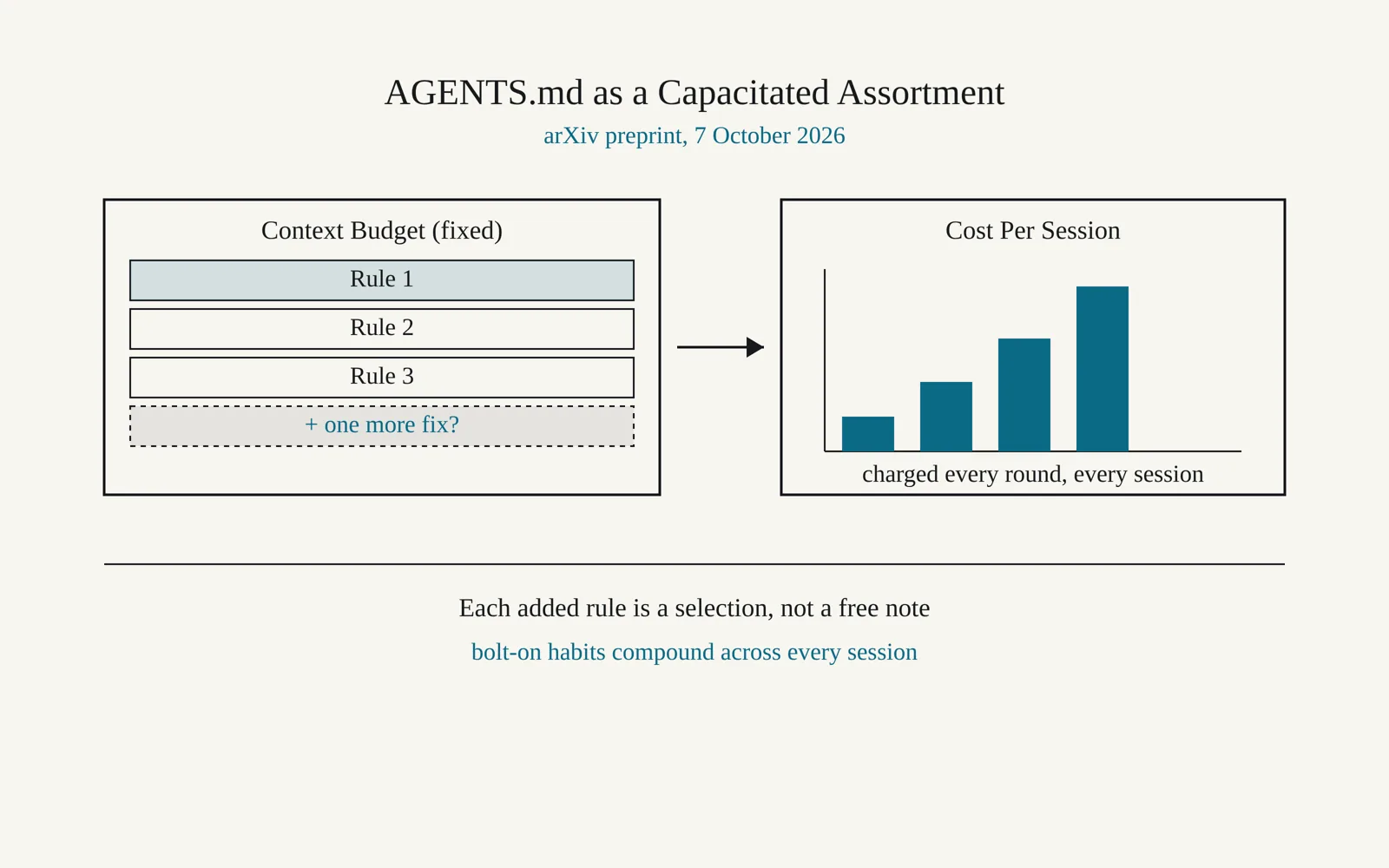
On 7 October 2026, researchers posted a preprint on arXiv arguing that the always-loaded context files AI agents read at the start of every session, such as AGENTS.md, should be treated as a capacitated assortment problem rather than a document that simply grows by appending instructions over time. (arXiv preprint 2610.11007, submitted 7 October 2026)
Open the photograph at full size
Photograph: Diagram: AI Journey
Read the full description of this diagram
Diagram drawn for this item: Paper Models AI Agent Context Files As a Capacitated Assortment Problem. On 7 October 2026, researchers posted a preprint on arXiv arguing that the always-loaded context files AI agents read at the start of every session, such as AGENTS.md, should be treated as a capacitated assortment problem rather than a... For anyone maintaining an agent's startup file, the result reframes a habit of bolting on one more rule after each failure as a cost that compounds every round of a session, since every token in that file gets charged again and again while...
What it means for you
For anyone maintaining an agent's startup file, the result reframes a habit of bolting on one more rule after each failure as a cost that compounds every round of a session, since every token in that file gets charged again and again while a crowded file can quietly lower how well the agent follows any single line, which argues for pruning before adding rather than treating length as safety.
In more detail
Researchers Zexuan Liu, Yuning Yang and Tiancheng Zhao posted a preprint on arXiv treating the context files that large language model agents load at the start of every session, files such as AGENTS.md, as a resource allocation problem rather than a static text block. Their framing is that each instruction kept in the file is loaded again in every later round of the session, so a file built by appending instruction after instruction keeps charging the same token cost over and over, and the paper reports that bloated files can degrade an agent’s performance as they grow.
The core contribution is a capacitated assortment model: instructions compete for a finite amount of attention capacity, adding one instruction never raises how well the agent follows the others already present, and each retained instruction carries a per-session setup cost on top of its token cost. The authors prove an upper bound on how large the optimal file can get no matter how many candidate instructions exist, and they show that appending every instruction with some standalone value can produce a worse outcome than deliberately choosing a smaller subset. A capped token budget, they find, also limits how badly things go wrong when the price of a token is underestimated.
The second half of the paper turns to how curators, human or automated, should learn what belongs in the file. Feedback on this kind of document is inherently incomplete: an instruction that is loaded generates visible signals of help or harm, while an instruction that was never added only produces feedback once its absence has already caused a problem. The authors show that deleting instructions an agent appears to be ignoring can end up removing instructions that were actually useful, and they set out how much evidence a curator should wait for before adding a new rule. They also bound how much a reviewer’s workflow suffers when only a limited number of edits can be inspected per period.
The numbers
- The paper proves a fixed upper bound on the optimal size of an always-loaded file, holding regardless of how many candidate instructions a curator has to choose from.
- Its experiments test the model against real context files rather than synthetic text, and report that irrelevant rules drawn from those files reduce how well a language model complies.
- The censored feedback result shows that an instruction’s absence produces a signal only after that absence has already caused harm, not before.
- A bound is also derived for a reviewer who can inspect only a capped number of edits in each period, rather than reviewing every change.
Sources
Sources read
arXiv preprint 2610.11007, submitted 7 October 2026 (arxiv.org)
Paper read
Cite this
AI Journey, "Paper Models AI Agent Context Files As a Capacitated Assortment Problem", 11 Oct 2026, https://aijourney.space/updates/2026-10-11-curating-always-loaded-context-for-llm-agents-a-capacitated-assortment-m/ (source: arXiv, verified 11 Oct 2026)
Next in the stream
Paper Proposes Distillation Methods To Expose Or Isolate Misaligned AI Models
A new preprint describes two distillation methods meant to either expose a misaligned AI model's hidden behavior or strip its capabilities clean of that behavior.
Previous
Paper Details Fix For Execution Gap In Nvidia's NVFP4 Training
Researchers published miniTE, a framework that fixes a numerical mismatch limiting reinforcement learning on Nvidia's native NVFP4 4-bit format.
Next
More in Research
Study Finds Precedent Labels Sway Claude Haiku Approval Calls
A new paper tests Claude Haiku 5.5 alongside other models on refund and claim decisions, showing that past case labels shift approvals sharply.
Paper Tests Claude Opus 4.8 Agents on Conflicting Code Edits
A new paper benchmarks Claude Code running Claude Opus 4.8 against other coding agents on tasks where two agents edit the same shared codebase at once.
Perplexity AI Researchers Detail LoRA Recipe For Converting Four Language Models To Diffusion
A paper associated with Perplexity AI describes BYOD, a LoRA-only method that converts standard autoregressive language models into diffusion language models without full retraining.