Event Published ResearchResearch
New Preprint Proposes Compact Recurrent Cell Named baseVultra
A new preprint proposes baseVultra, a compact recurrent cell that moves capacity from gate transforms to candidate generation and reports gains at small hidden sizes.
What happened
Published here
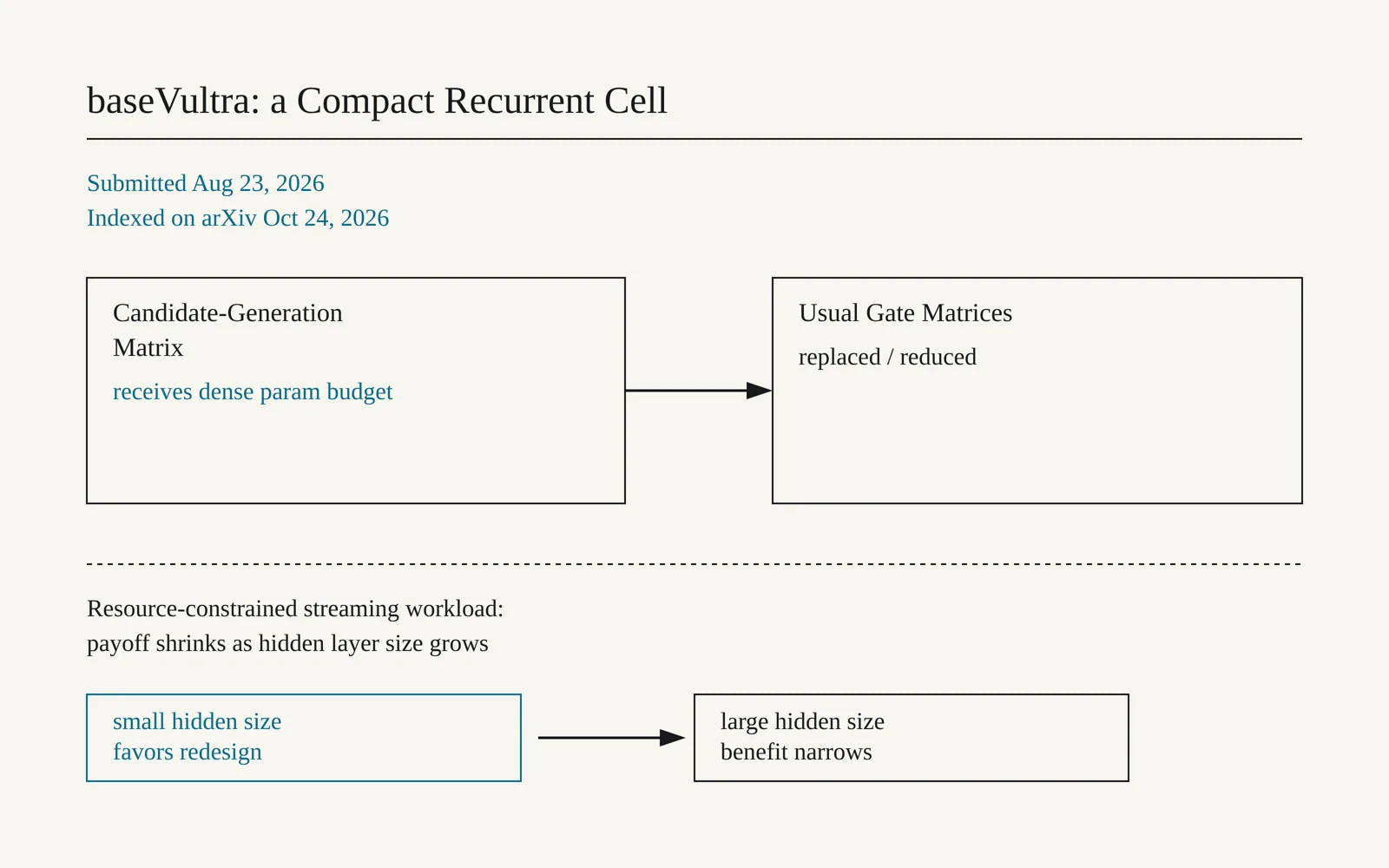
Submitted on August 23, 2026 and indexed on arXiv on October 24, 2026, the paper describes baseVultra, a recurrent cell that concentrates its dense parameter budget on one candidate-generation matrix and replaces the usual gate matrices with lighter diagonal interactions, then reports benchmark comparisons against parameter-matched LSTM and GRU cells on character-level language modeling and formal-language probes. (arXiv preprint 2610.30154, baseVultra: Compact Nonlinear Recurrence with Reallocated Capacity, submitted August 23, 2026)
Open the photograph at full size
Photograph: Diagram: AI Journey
Read the full description of this diagram
Diagram drawn for this item: New Preprint Proposes Compact Recurrent Cell Named baseVultra. Submitted on August 23, 2026 and indexed on arXiv on October 24, 2026, the paper describes baseVultra, a recurrent cell that concentrates its dense parameter budget on one candidate-generation matrix and replaces the usual gate matrices... For anyone choosing a recurrent architecture for a resource-constrained streaming workload, the paper's own numbers suggest the payoff from this redesign shrinks once the hidden layer grows past a small size, so the decision hinges on...
The numbers
baseVultra validation loss
1.594
TinyShakespeare, compact one-layer 200K setting
LSTM validation loss
1.604
Parameter-matched LSTM, same setting
Dense compute share
54%
baseVultra's dense recurrent matrix-vector cost vs GRU, matched hidden size
text8 benchmark size
45x
Roughly how much larger text8 is than TinyShakespeare in this study
What it means for you
For anyone choosing a recurrent architecture for a resource-constrained streaming workload, the paper's own numbers suggest the payoff from this redesign shrinks once the hidden layer grows past a small size, so the decision hinges on whether a deployment target is genuinely capacity-limited or just budget-conscious. A team building an edge device or a low-memory sequence model gets a concrete trade to weigh: a smaller, cheaper cell that wins on tight capacity but loses its edge as soon as hidden size scales up, which narrows where this design choice actually pays off rather than offering a universal swap for LSTM or GRU.
In more detail
Recurrent neural networks built from gated cells like the LSTM and the GRU have mostly been pushed aside by transformers for large-scale language work, but they remain a practical choice for streaming sequence tasks where processing has to happen one step at a time with a fixed, small memory footprint. The new preprint asks a narrow design question inside that smaller world: instead of spending most of a cell’s parameters on the gates that control what gets remembered, what happens if most of that budget goes to the branch that generates the candidate update itself.
The proposed cell, called baseVultra, keeps one dense H by H matrix for candidate generation and swaps the usual dense gate matrices for lighter diagonal interactions, adding two small auxiliary branches, a running average cache, and a learned way of blending outputs. The gates also get limited access to the state from two steps back through simple diagonal terms, a cheap way to give them a bit of longer memory without adding a full matrix.
On TinyShakespeare, a small character-level text dataset, baseVultra edges out parameter-matched LSTM and GRU cells on validation loss while using noticeably less dense computation than GRU at matched hidden size. On text8, a dataset the paper describes as roughly forty five times larger, the advantage narrows to roughly a tie with the older cells. On synthetic formal-language tests designed to probe how well a cell tracks structure with little memory to work with, baseVultra’s advantage is largest when the hidden state is small and fades as the hidden size grows, which the authors read as the central finding: this reallocation of capacity helps most exactly when memory is scarce, and stops mattering once a model has room to spare.
The numbers
The paper reports a validation loss of 1.594 for baseVultra against 1.604 for a matched LSTM and 1.616 for a matched GRU on the TinyShakespeare task, with baseVultra’s dense recurrent computation running at about 54% of GRU’s under the same hidden size. On the roughly 45x larger text8 benchmark the gap mostly disappears, with baseVultra at 1.854 bits per character against 1.849 for GRU and 1.837 for LSTM. The paper notes it was revised after review feedback from an academic conference, with one weak accept and two borderline scores recorded in its submission history.
Sources
Sources read
Cite this
AI Journey, "New Preprint Proposes Compact Recurrent Cell Named baseVultra", 24 Oct 2026, https://aijourney.space/updates/2026-10-24-basevultra-compact-nonlinear-recurrence-with-reallocated-capacity/ (source: arXiv, verified 24 Oct 2026)
Next in the stream
Paper Tests Claude Haiku 4.5 on Legal Clause Drafting Risk
A new academic paper evaluates Anthropic's Claude Haiku 4.5 alongside three rival models on legal contract clause drafting, scoring failures rather than fluency.
Previous
Anthropic opens a $5 million grant program for independent wellbeing evaluations
Anthropic will fund independent, open-source research into how AI affects user wellbeing with $5 million, model access and support, with applications closing on 21 September 2026.
Next
More in Research
Study Finds Precedent Labels Sway Claude Haiku Approval Calls
A new paper tests Claude Haiku 5.5 alongside other models on refund and claim decisions, showing that past case labels shift approvals sharply.
Paper Tests Claude Opus 4.8 Agents on Conflicting Code Edits
A new paper benchmarks Claude Code running Claude Opus 4.8 against other coding agents on tasks where two agents edit the same shared codebase at once.
Perplexity AI Researchers Detail LoRA Recipe For Converting Four Language Models To Diffusion
A paper associated with Perplexity AI describes BYOD, a LoRA-only method that converts standard autoregressive language models into diffusion language models without full retraining.