What happened
Published here
On October 23, 2026, researcher Karan Yadav published a paper running the first independent audit of a frozen 'System One' content moderation model, testing it against 14 frontier reasoning systems, including Anthropic's Claude alongside the GPT-5.x, Gemini 3 and Grok families, on 142,658 human-labeled comments. (arXiv paper 2610.33258, 'Two Uncertainties Are Not One', submitted October 23, 2026)
Open the photograph at full size
Photograph: Diagram: AI Journey
Read the full description of this diagram
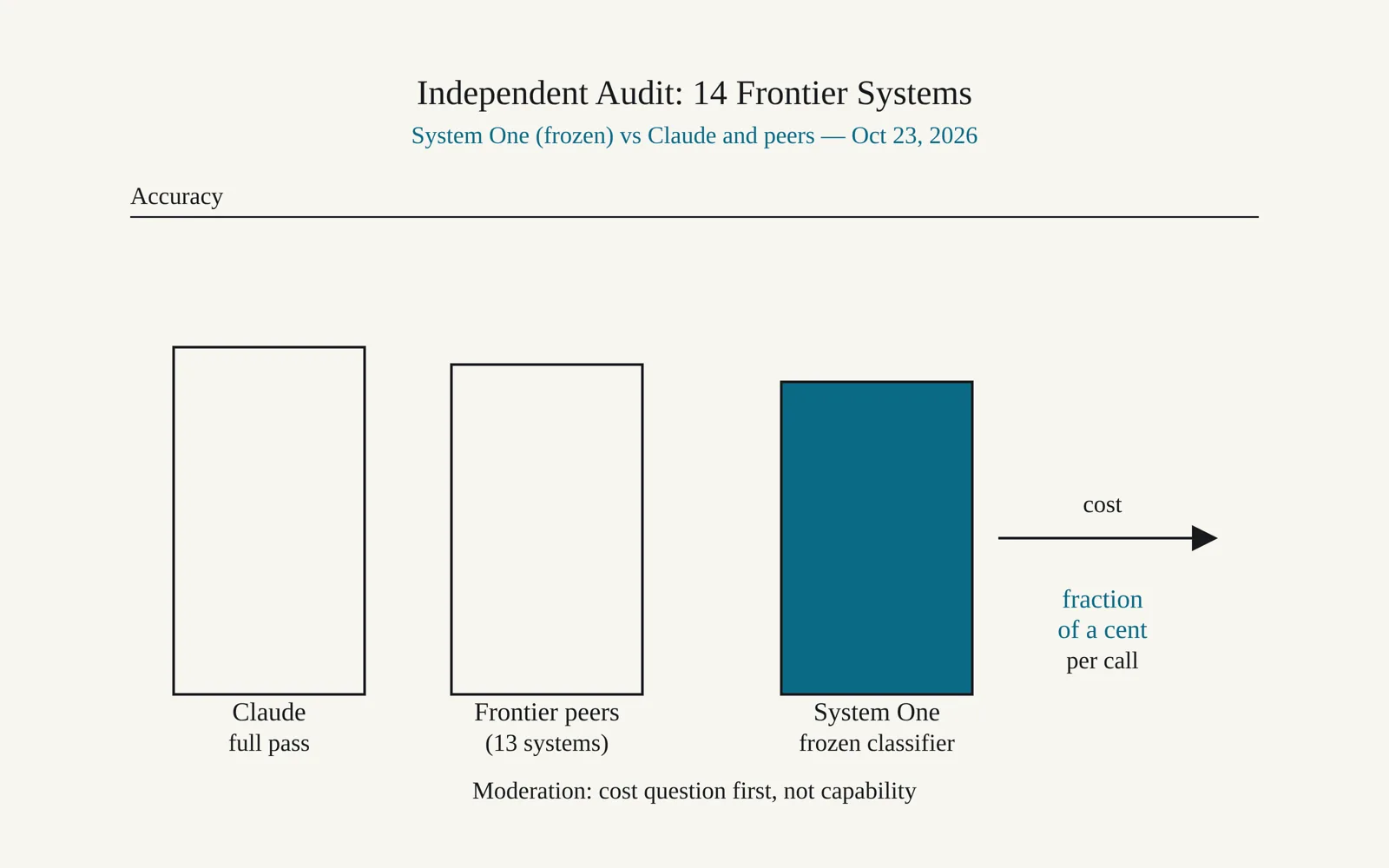
Diagram drawn for this item: Independent Audit Finds Cheap Moderation Model Rivals Claude. On October 23, 2026, researcher Karan Yadav published a paper running the first independent audit of a frozen 'System One' content moderation model, testing it against 14 frontier reasoning systems, including Anthropic's Claude alongside... For a team deciding whether every flagged post needs a full pass through Claude or a comparable frontier model, this reframes the choice as a cost question first: a classifier priced at a fraction of a cent per call reaches an accuracy...
The numbers
Comments audited
142,658
Human-labeled comments used in the audit
Frontier models tested
14
Reasoning systems benchmarked against the cheap model
Zero-shot AUROC
0.83
Accuracy score of the cheap model on the shared probe set
Cost per call
USD 0.000025
Price of the cheap model, roughly, per call
Read from arXiv paper 2610.33258, 'Two Uncertainties Are Not One', submitted October 23, 2026
What it means for you
For a team deciding whether every flagged post needs a full pass through Claude or a comparable frontier model, this reframes the choice as a cost question first: a classifier priced at a fraction of a cent per call reaches an accuracy score the paper could not statistically distinguish from most of the larger systems, so the harder budget decision becomes where to spend the savings, since the same work shows a single confidence score can still hide disagreement a human reviewer would catch before an appeal.
In more detail
Content moderation at the scale of billions of posts cannot afford to run a frontier model on every item, which is the problem a new paper takes on directly. Published on October 23, 2026 by researcher Karan Yadav, the work runs what it calls the first independent audit of a frozen “System One” moderation model, a system that returns typed, calibrated decisions rather than text, priced at roughly USD 0.000025 per call and answering in around 100 milliseconds. The audit tests it against 14 frontier reasoning models on a shared probe set, including Anthropic’s Claude alongside the GPT-5.x, Gemini 3 and Grok families, over 142,658 human-labeled comments.
The headline result is that the cheap model holds its own on raw accuracy. Its zero-shot classification score, an AUROC of 0.83, could not be statistically separated from 13 of the 14 frontier systems in a paired bootstrap test, a result the author is careful to call a failure to reject parity rather than proof the systems are equal. The cheap model also matched or beat several of the larger systems on calibration, while costing one to three orders of magnitude less to run.
The second finding complicates the first. The paper argues that “confidence” in these systems actually conflates two separate things: human disagreement, which shows up on satire and coded language where annotators themselves split, and decision risk, the cost of an automated action going wrong. The paper says these call for opposite escalation signals, so a single confidence number cannot serve both. Splitting a judgment into parallel sub-questions can recover a disagreement signal the model’s own confidence misses, but the paper notes this fix is narrow: it helps only the weakest, disagreement-blind models, not a specialist toxicity model or the strongest large language models, and its benefit shifts with the data it is tested on.
The numbers
- 142,658 human-labeled comments formed the audit set.
- 14 frontier reasoning models, spanning the GPT-5.x, Claude, Gemini 3 and Grok families, were benchmarked on the same probe set.
- The cheap model’s zero-shot AUROC came in at 0.83.
- Each call to the cheap model cost roughly USD 0.000025, against the price of running a full reasoning model on the same post.
The author plans to release the instrument, the cached runs and the analysis, which would let other moderation teams check the comparison against their own data rather than take the headline number on faith.
Sources
Sources read
arXiv paper 2610.33258, 'Two Uncertainties Are Not One', submitted October 23, 2026 (arxiv.org)
Paper read
Cite this
AI Journey, "Independent Audit Finds Cheap Moderation Model Rivals Claude", 27 Oct 2026, https://aijourney.space/updates/2026-10-27-two-uncertainties-are-not-one-disagreement-versus-decision-risk-in-cheap/ (source: arXiv, verified 27 Oct 2026)
Next in the stream
Paper Finds Vague Tool Output Wording Can Mislead AI Agents and Their Verifiers
A new paper, with an audit prompt tested on Codex and Claude Code, shows vague tool output wording can mislead AI agents and the verifiers meant to catch their errors.
Previous
Gemini 2.5 Pro Tested in Multi-Agent Drug Safety Causality Framework
Researchers built a four-agent causality assessment system using Google's Gemini 2.5 Pro and DeepSeek-V3.2 to review drug safety case reports against expert judgment.
Next
More in Anthropic
Paper Finds Claude Opus 5.5 Agent Beats Automated CT Labeling Harness
A new paper testing CT scan labeling finds a free-form agent running Claude Opus 5.5 outscored an automated review harness on most of six public datasets.
Paper Finds Claude Opus 5 Often Skips Procedure To Reach Right Outcome
A new benchmark testing patient-advocacy agents found Claude Opus 5 reached correct outcomes often but passed procedural checks far less consistently.
Paper Introduces TSFLab Workbench To Cut Agent Research Costs
A new paper proposes TSFLab, a workbench that lets coding agents such as Claude Code run time series forecasting research at lower cost and with less manual upkeep.