What happened
Published here
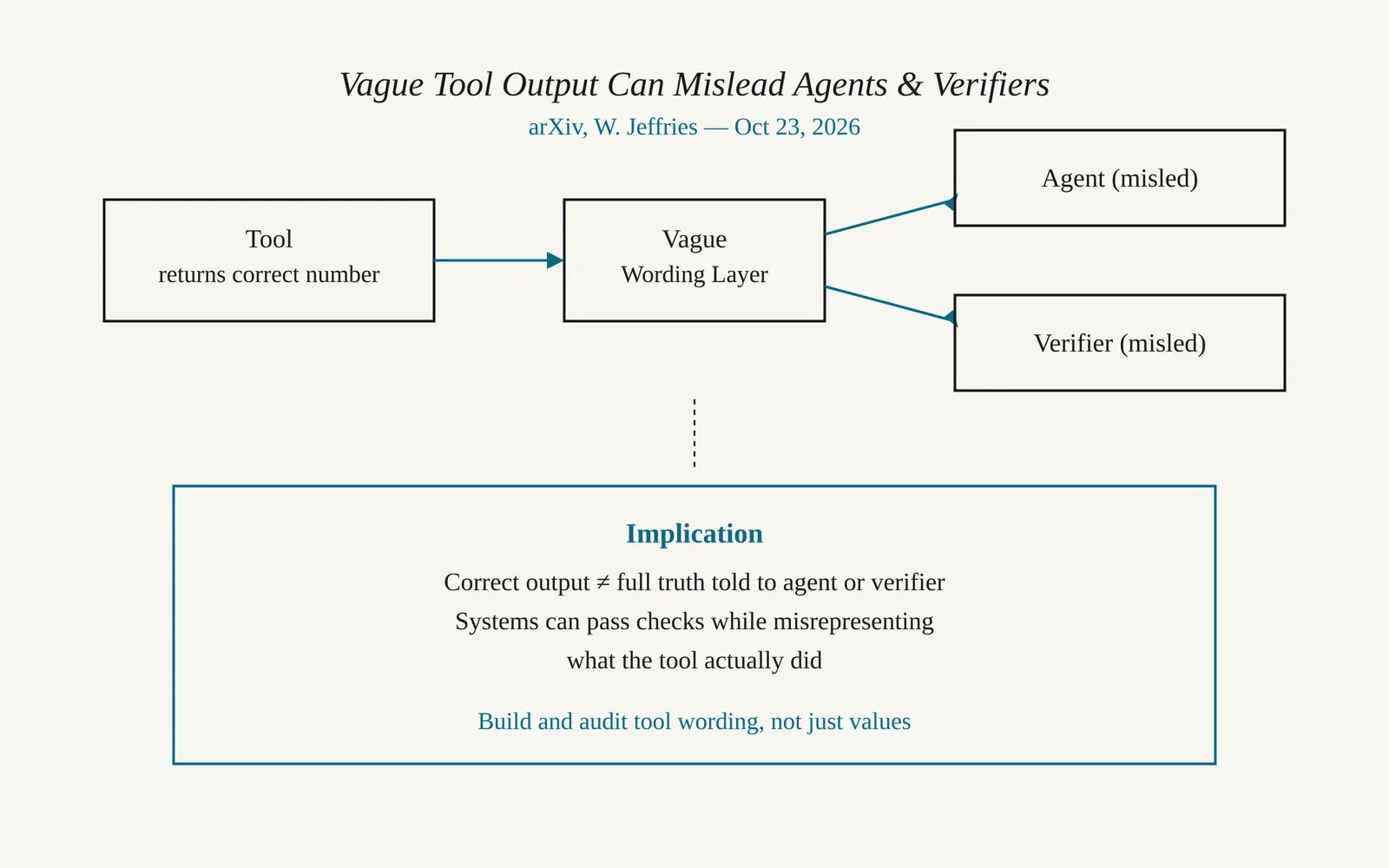
On October 23, 2026, researcher William Jeffries posted a paper on arXiv showing that tool output formatters in agentic AI systems can mislead both the agent using them and a separate verifier checking the agent's claims, drawing on a production retrieval system used by the Pilsudski Institute in New York where each tool computed the right answer but its printed summary left out search limits, result caps or identifier namespaces. (arXiv preprint 2610.32110, Who Verifies the Tools? How Warped Formatters Mislead Agents and Their Verifiers, submitted October 23, 2026)
Open the photograph at full size
Photograph: Diagram: AI Journey
Read the full description of this diagram
Diagram drawn for this item: Paper Finds Vague Tool Output Wording Can Mislead AI Agents and Their Verifiers. On October 23, 2026, researcher William Jeffries posted a paper on arXiv showing that tool output formatters in agentic AI systems can mislead both the agent using them and a separate verifier checking the agent's claims, drawing on a... For anyone building or buying agent pipelines, the finding means a tool returning the correct number is not the same as a tool telling the agent, or a verifier checking the agent, the full truth about what it did, so a system can pass...
The numbers
Verifiers before fix
90 out of 90
Times verifiers accepted an incorrect answer using the unrepaired formatter
Verifiers after fix
90 out of 90
Times the same verifiers rejected the incorrect answer once wording was repaired
Paper length
12 pages
What it means for you
For anyone building or buying agent pipelines, the finding means a tool returning the correct number is not the same as a tool telling the agent, or a verifier checking the agent, the full truth about what it did, so a system can pass every test while still handing users a wrong or incomplete answer. The paper's own audit prompt, which the author ran against Codex and Claude Code, gives engineering teams a concrete way to check their own formatters rather than wait for the same gap to surface in front of a customer, and the same prompt also found warped formatters in two widely used open-source agent frameworks.
In more detail
A paper posted to arXiv on October 23, 2026, by researcher William Jeffries addresses a problem that sits below the level most AI safety work looks at: not whether a tool computes the right answer, but whether the text it prints back to an agent says so honestly. The author traces the issue to a production retrieval-augmented generation system used by the Pilsudski Institute in New York, where tools were computing correctly but their output formatters quietly dropped details such as search limits, result caps and identifier namespaces. An agent reading that trimmed-down text then gave users answers that were wrong or incomplete, even though nothing in the underlying computation had failed.
To measure how much the missing wording mattered, the paper fed identical tool results to agents through two formatter versions, one with the omissions and one stating every missing detail plainly. That single change in wording altered both what the agents claimed afterward and what a separate verifier model accepted as correct. Unsupported claims from the agent fell for three of four failure types tested, and in one test a verifier that had been accepting an incorrect answer in all 90 trials rejected it in all 90 trials once the formatter was repaired. A control test confirmed the verifiers were capable of catching the errors all along, once given the missing facts and asked to judge correctness directly.
The paper also describes an audit prompt the author wrote using Codex and Claude Code, built with prior knowledge of the defects already found in the Pilsudski system. Run against an older version of that same system, the prompt rediscovered the known defects and surfaced twelve more that had not been catalogued. Pointed at two well known open-source agent frameworks, OpenClaw and Hermes, it found warped formatters in both, and a fix for OpenClaw has already been merged.
The numbers
The clearest figure in the paper is the swing in verifier behaviour: 90 out of 90 acceptances of a wrong answer before the formatter was fixed, 90 out of 90 rejections of the same wrong answer afterward. That is not a small improvement at the margin, it is a complete reversal driven by wording alone, with no change to the tool’s actual computation. The paper runs 12 pages and was accepted as a poster at a NeurIPS 2026 workshop on verifying agents, and the author states the audit prompt is available for any team to run against its own systems today.
Sources
Sources read
Cite this
AI Journey, "Paper Finds Vague Tool Output Wording Can Mislead AI Agents and Their Verifiers", 27 Oct 2026, https://aijourney.space/updates/2026-10-27-who-verifies-the-tools-how-warped-formatters-mislead-agents-and-their-ve/ (source: arXiv, verified 27 Oct 2026)
Next in the stream
OpenAI Details Tighter Security For Frontier Model Training
OpenAI said it strengthened containment around how it trains frontier models, moving some ChatGPT-building work to offline environments with heavier red-teaming.
Previous
Independent Audit Finds Cheap Moderation Model Rivals Claude
A new paper benchmarks a cheap content moderation model against Claude and 13 other frontier reasoning systems, finding it holds up on accuracy at a fraction of the price.
Next
More in Anthropic
Paper Finds Claude Opus 5.5 Agent Beats Automated CT Labeling Harness
A new paper testing CT scan labeling finds a free-form agent running Claude Opus 5.5 outscored an automated review harness on most of six public datasets.
Paper Finds Claude Opus 5 Often Skips Procedure To Reach Right Outcome
A new benchmark testing patient-advocacy agents found Claude Opus 5 reached correct outcomes often but passed procedural checks far less consistently.
Paper Introduces TSFLab Workbench To Cut Agent Research Costs
A new paper proposes TSFLab, a workbench that lets coding agents such as Claude Code run time series forecasting research at lower cost and with less manual upkeep.