Event Published ResearchResearch
Paper Introduces Benchmark For Controllable Speaking-Style Captioning
A new paper posted to arXiv introduces StyleInstructCaps, a benchmark that tests whether audio-language models can describe speech delivery on command rather than with one fixed caption.
What happened
Published here
On October 15, 2026, researchers posted a paper to arXiv describing StyleInstructCaps, the first standardized benchmark for controllable speaking-style captioning, a task where a model must describe a chosen aspect of how speech is delivered, such as vocal timbre, prosody or emotion, rather than producing one undifferentiated caption for the whole clip. The paper, accepted at AACL 2026, formulates the task as instruction following: an audio-language model receives an explicit instruction naming which speaking-style dimension to describe, then generates a caption grounded in that instruction. The authors tested nine audio-language models against the benchmark and released the dataset, evaluation framework and code alongside the paper. (arXiv preprint, A Benchmark for Controllable Speaking-Style Captioning in Audio-Language Models, posted October 15, 2026)
Open the photograph at full size
Photograph: Diagram: AI Journey
Read the full description of this diagram
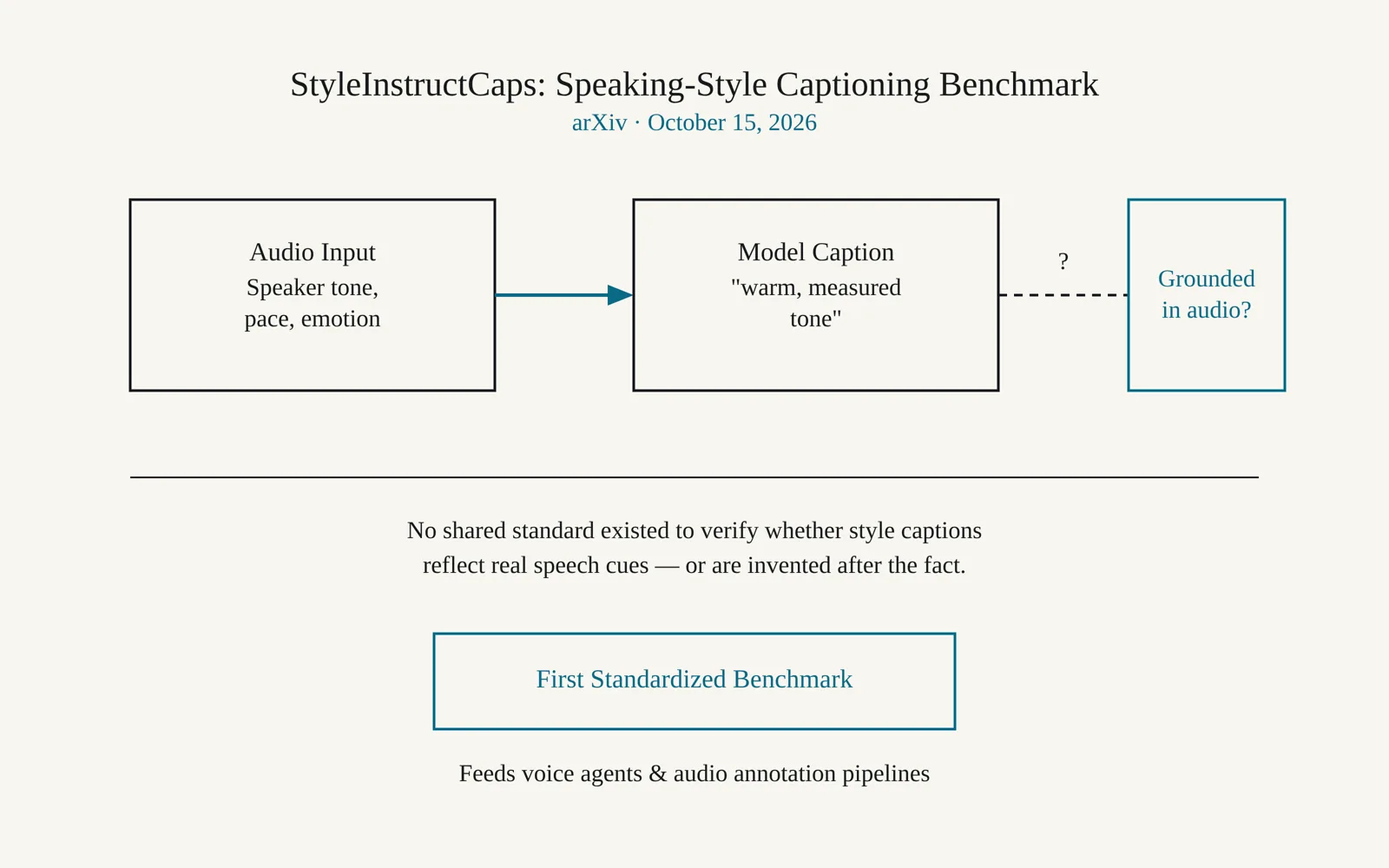
Diagram drawn for this item: Paper Introduces Benchmark For Controllable Speaking-Style Captioning. On October 15, 2026, researchers posted a paper to arXiv describing StyleInstructCaps, the first standardized benchmark for controllable speaking-style captioning, a task where a model must describe a chosen aspect of how speech is... Teams building voice agents or audio annotation pipelines have had no shared way to check whether a model's caption of a speaker's tone is grounded in the actual audio or invented after the fact, which matters once that caption feeds a...
What it means for you
Teams building voice agents or audio annotation pipelines have had no shared way to check whether a model's caption of a speaker's tone is grounded in the actual audio or invented after the fact, which matters once that caption feeds a downstream decision such as flagging distress in a call centre transcript or tagging mood in a dataset of recordings. A benchmark that scores groundedness and hallucination separately from instruction following gives a team a concrete reason to swap a captioning model rather than trusting a demo that merely looks fluent.
In more detail
Speaking-style captioning asks a model to put into words how something was said, not just what was said. Existing systems tend to produce one general description per clip, covering timbre, pacing and emotion all at once, which is of limited use to an application that only needs to know whether a speaker sounded urgent, or whether their accent matches a target profile. The paper reframes the task as instruction following: a user specifies which dimension of delivery they want described, and the model answers that instruction specifically rather than defaulting to a catch-all summary.
To make that claim testable, the authors built StyleInstructCaps, a dataset and evaluation framework rather than a single leaderboard number. It checks several things a caption could fail at independently: whether the words are grounded in details actually present in the metadata, whether the model invents attributes that are not supported by the audio, whether it actually follows the instruction it was given rather than ignoring it, whether performance holds up on instructions and audio sources it was never trained on, and whether its description of one speaker stays consistent across different clips of that speaker.
The headline finding is a gap between two capabilities that sound similar but are not. Models that follow instructions accurately, in the narrow sense of producing an answer shaped the way the prompt asked for, do not reliably produce captions that are actually grounded in the speech itself. The paper also reports that training on data built specifically for this instruction-diverse, dimension-specific setup produces clear improvements across groundedness, controllability and speaker consistency, rather than general-purpose audio-language training alone closing that gap.
The numbers
The benchmark was tested against nine state-of-the-art audio-language models, covering a spread of current approaches to audio understanding rather than a single family. The evaluation framework measures five separate properties: metadata groundedness, hallucination, instruction-following ability, generalization to unseen instructions and datasets, and speaker-style consistency, which lets a team diagnose which of those a given model is weak on instead of reading a single blended score. The paper was accepted at AACL 2026, and the authors have released the dataset, evaluation code and benchmark publicly alongside the preprint, so other groups can run their own models against the same checks rather than taking the reported results on faith.
Sources
Sources read
Cite this
AI Journey, "Paper Introduces Benchmark For Controllable Speaking-Style Captioning", 28 Oct 2026, https://aijourney.space/updates/2026-10-28-a-benchmark-for-controllable-speaking-style-captioning-in-audio-language/ (source: arXiv, verified 28 Oct 2026)
Next in the stream
Paper Proposes Jury Model To Rate AI Ensemble Reliability
A new paper posted to arXiv on October 15, 2026 treats a group of language models as a jury whose trustworthiness is learned without any labelled data.
Previous
Gemini Notebook Adds Short Video and Quiz Study Tools
Google added three study features to Gemini Notebook, including short video overviews and new quiz formats, aimed at exam preparation.
Next
More in Research
Perplexity AI Researchers Detail LoRA Recipe For Converting Four Language Models To Diffusion
A paper associated with Perplexity AI describes BYOD, a LoRA-only method that converts standard autoregressive language models into diffusion language models without full retraining.
Gemini Negotiation Paper Finds Persona Effects Shift By Language
A new paper testing Google's Gemini model in buyer-seller negotiations found that the same persona instruction produced different deal outcomes in English and Korean.
Paper Finds Gemini Monitor Beats Small Models At Spotting Reward Hacking
A new paper tests whether Google's Gemini 3.1 Flash-Lite can tell real reward hacking apart from honest failure better than small local monitors.