Event Published ResearchResearch
Paper Proposes Jury Model To Rate AI Ensemble Reliability
A new paper posted to arXiv on October 15, 2026 treats a group of language models as a jury whose trustworthiness is learned without any labelled data.
What happened
Published here
On October 15, 2026, researchers posted a paper to arXiv describing a method that estimates how much to trust each model in a group of language models using only the pattern of agreement among their answers, with no labelled training data required. (arXiv preprint, submitted October 15, 2026)
Open the photograph at full size
Photograph: Diagram: AI Journey
Read the full description of this diagram
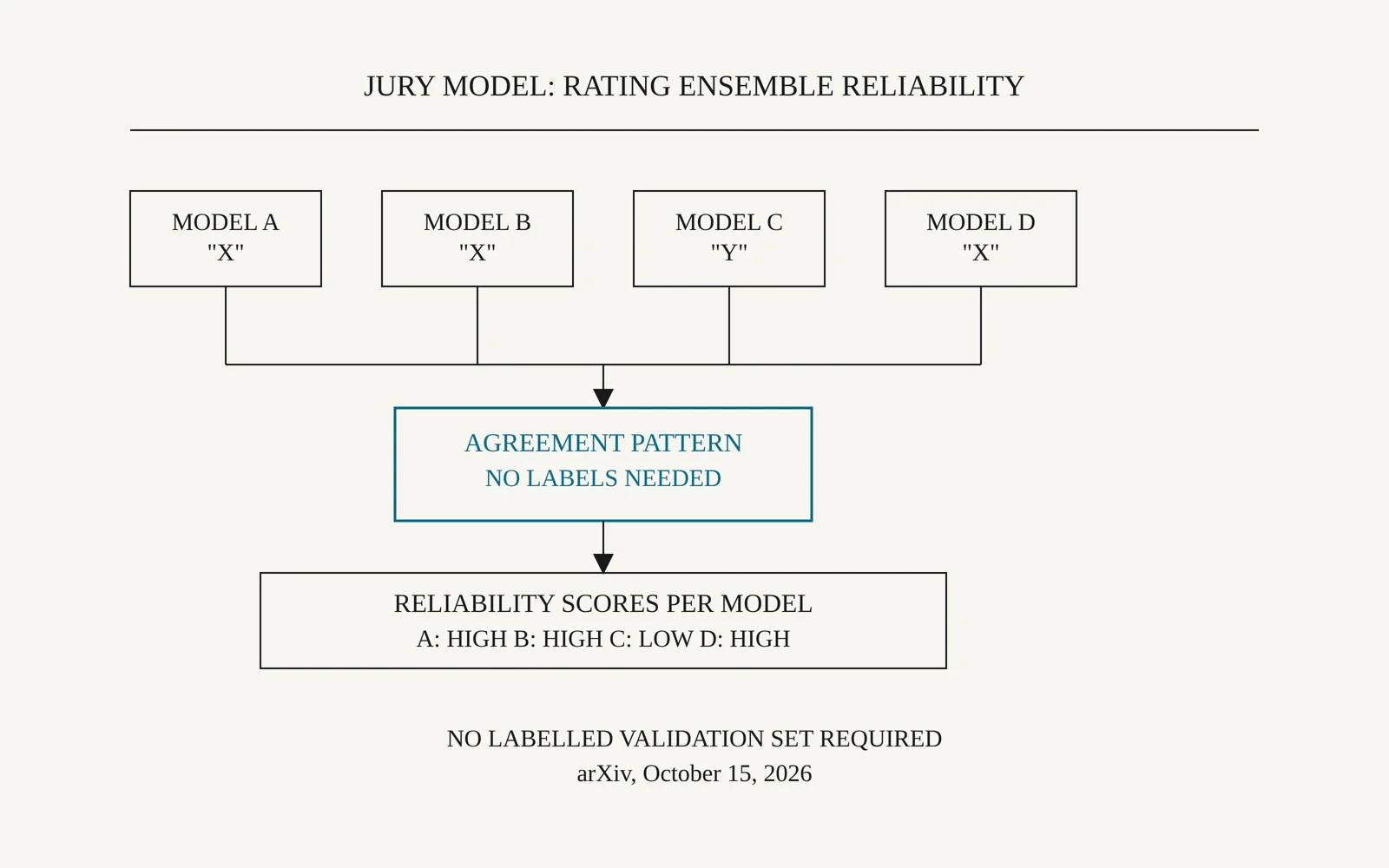
Diagram drawn for this item: Paper Proposes Jury Model To Rate AI Ensemble Reliability. On October 15, 2026, researchers posted a paper to arXiv describing a method that estimates how much to trust each model in a group of language models using only the pattern of agreement among their answers, with no labelled training data... For a team running several models side by side to check each other's work, this removes the need to collect a labelled validation set before deciding which model to weight more heavily, since the reliability scores come from watching the...
The numbers
Benchmark size
1560-question
Size of the benchmark used to test the method
Expert count
nine
Number of experts in the tested jury
Max expert size
3B
Largest parameter count among the tested experts
What it means for you
For a team running several models side by side to check each other's work, this removes the need to collect a labelled validation set before deciding which model to weight more heavily, since the reliability scores come from watching the models answer, which changes the workflow for building a review panel rather than just scoring one.
In more detail
Researchers from a four-person team posted a paper to arXiv on October 15, 2026 that reframes how a group of language models should be combined. Instead of treating every model’s vote the same way, or fixing each model’s reputation ahead of time from labelled data, the paper models the group as a jury: each question has one true answer, every expert reports a guess with some unknown reliability, and that reliability is estimated purely from how often each expert’s answers line up with the others. The method uses Expectation Maximisation to pull those reliability scores out of unlabelled answer patterns alone, then folds them into what the authors show reduces to a log odds weighted linear score across the experts’ answer distributions.
The authors tested the idea on a benchmark of 1560 questions, pairing nine experts with up to 3B parameters each. The jury’s label-free scoring performed comparably to the same fusion rule given label-fitted weights, meaning the paper found no statistically significant benefit from having access to ground truth labels for calibrating the panel. The jury version also beat the best single model when that model was given matched self-consistency sampling, and it beat the strongest label-free alternative method across the full question set.
The numbers
The benchmark ran to 1560 questions, large enough to let the reliability estimates settle rather than resting on a handful of trial questions. The tested jury used nine experts, each no larger than 3B parameters, which is a modest size by current standards and suggests the gains come from how the panel is scored rather than from throwing bigger models at the problem. The paper itself runs 35 pages with four figures and 13 tables in its appendices, reflecting the breadth of the ablations the authors ran to check the method against labelled alternatives.
For anyone assembling a panel of smaller, cheaper models to check each other rather than running one large model alone, the result suggests that collecting labelled validation data to calibrate trust weights may be unnecessary overhead. A team could instead let the panel score itself from its own pattern of agreement, cutting a data collection step out of a workflow that otherwise needs it before any fusion rule can be tuned with confidence. That is a different kind of saving than a lower bill or a higher rate limit, but it is a real one: fewer labelled examples to source, annotate and maintain before a multi-model review process can be trusted at all.
Sources
Sources read
arXiv preprint, submitted October 15, 2026 (arxiv.org)
Paper read
Cite this
AI Journey, "Paper Proposes Jury Model To Rate AI Ensemble Reliability", 16 Oct 2026, https://aijourney.space/updates/2026-10-16-a-jury-not-an-electorate-label-free-reliability-estimation-for-ensembles/ (source: arXiv, verified 16 Oct 2026)
Next in the stream
Google Adds Gemini 4 Argon Access To Paid Gemini Subscriptions
Google's Gemini subscription page now promotes Gemini 4 Argon access for AI Pro and AI Ultra subscribers, with plan prices unchanged from the prior structure.
Previous
Paper Introduces Benchmark For Controllable Speaking-Style Captioning
A new paper posted to arXiv introduces StyleInstructCaps, a benchmark that tests whether audio-language models can describe speech delivery on command rather than with one fixed caption.
Next
More in Research
Study Finds Precedent Labels Sway Claude Haiku Approval Calls
A new paper tests Claude Haiku 5.5 alongside other models on refund and claim decisions, showing that past case labels shift approvals sharply.
Paper Tests Claude Opus 4.8 Agents on Conflicting Code Edits
A new paper benchmarks Claude Code running Claude Opus 4.8 against other coding agents on tasks where two agents edit the same shared codebase at once.
Perplexity AI Researchers Detail LoRA Recipe For Converting Four Language Models To Diffusion
A paper associated with Perplexity AI describes BYOD, a LoRA-only method that converts standard autoregressive language models into diffusion language models without full retraining.